The Fusion of Design Freedom and Manufacturing Agility
Additive manufacturing was once a peripheral player in manufacturing technology. It was used for rapid prototyping, sample demonstrations, and small batch verification, but never truly entered mainstream production. Slow speed, high cost, limited materials, and insufficient precision kept additive manufacturing long regarded as a supplement to traditional manufacturing processes rather than a replacement.
This landscape is rapidly changing. Equipment speeds are increasing, material varieties are expanding, precision is improving, and costs are declining. Additive manufacturing is evolving from a prototyping tool into a production mainstay. Simultaneously, the integration of artificial intelligence is transforming additive manufacturing from process parameter driven to intelligent process control, enabling this technology to enter mass production with a flexibility and complexity that traditional manufacturing cannot match.
The core proposition of additive manufacturing platforms is not to replace traditional manufacturing but to expand the boundaries of manufacturing possibility. It liberates design from traditional process constraints, frees production from the limitations of molds and tooling, and releases supply chains from the restrictions of minimum order quantities and inventory costs.
The Manufacturing Paradox
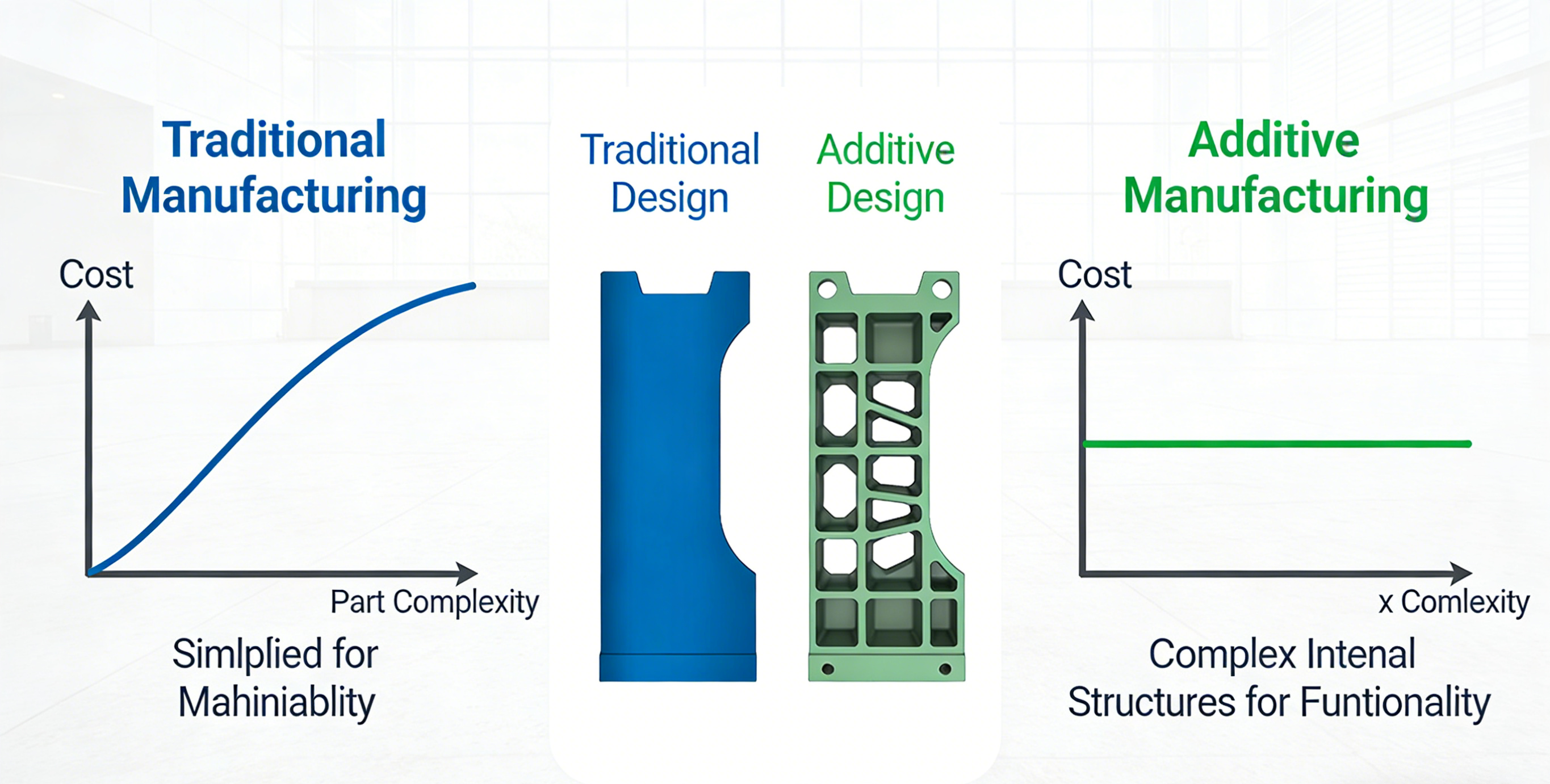
Traditional manufacturing processes suffer from a fundamental paradox: complexity correlates with cost. The more complex a part, the more complex its mold, the more processing steps required, the more intricate its assembly, and costs rise exponentially. Designers are therefore forced to compromise between functional requirements and process feasibility. The optimal functional design often cannot be manufactured, and the manufacturable design is often not optimal.
Additive manufacturing breaks this paradox. In additive manufacturing, complexity is essentially unrelated to cost. A complex internal channel and a simple cube require nearly identical printing time and material consumption. Designers no longer need to compromise on manufacturability and can focus entirely on functionally optimal designs.
Design as Manufacturing
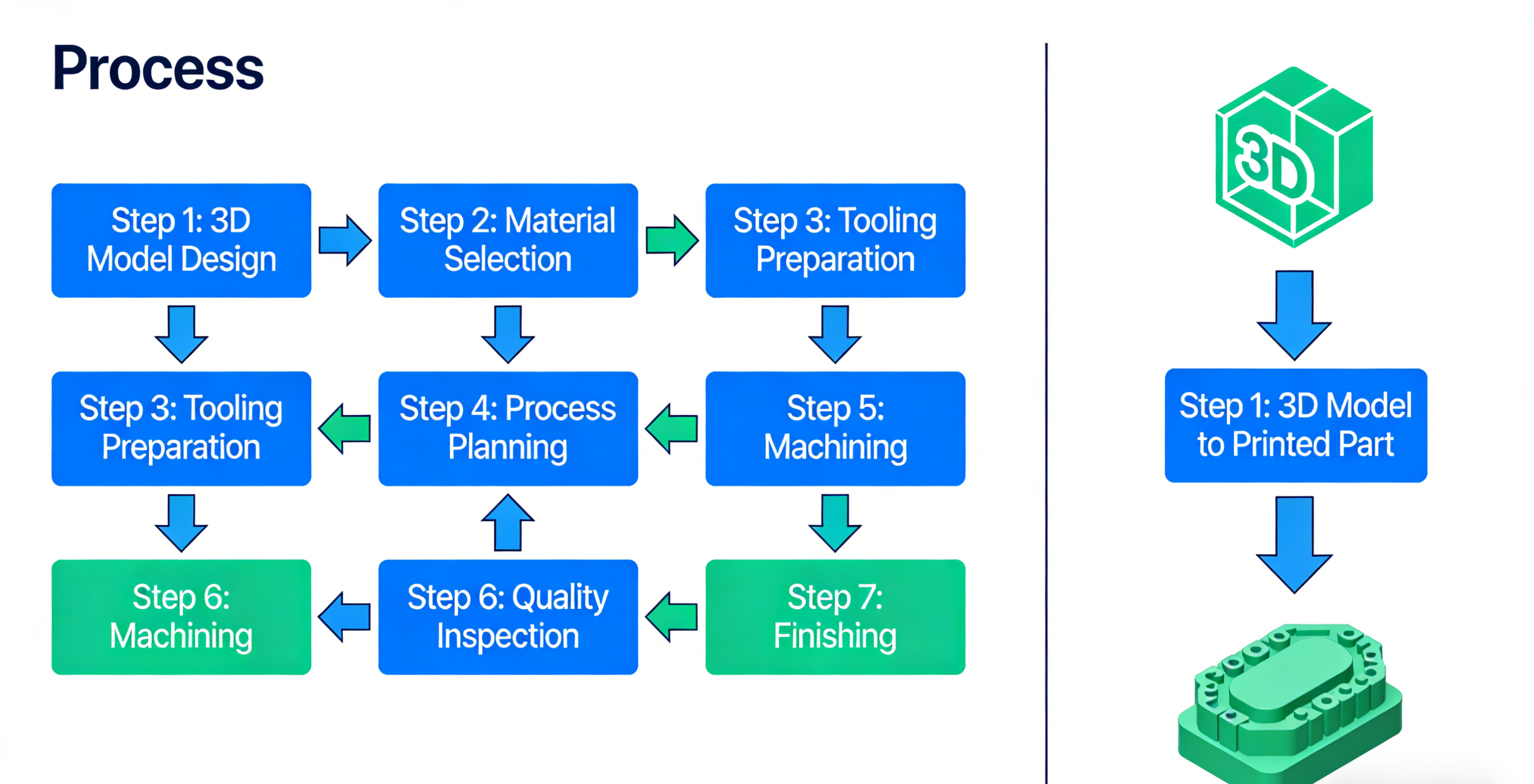
In traditional manufacturing, a natural gap exists between design and manufacturing. Designers create three dimensional models, process engineers transform them into manufacturable process plans, and manufacturing engineers execute production. This process involves multiple transformations, each potentially losing information and introducing deviation.
Additive manufacturing eliminates this gap. Three dimensional models are directly input to printers, without molds, without tooling, without fixtures. Design is manufacturing. The transformation steps between digital model and physical part are compressed to the minimum. Designers can intuitively see how their designs translate into physical objects, and process decisions are completed during design rather than adjusted during manufacturing.
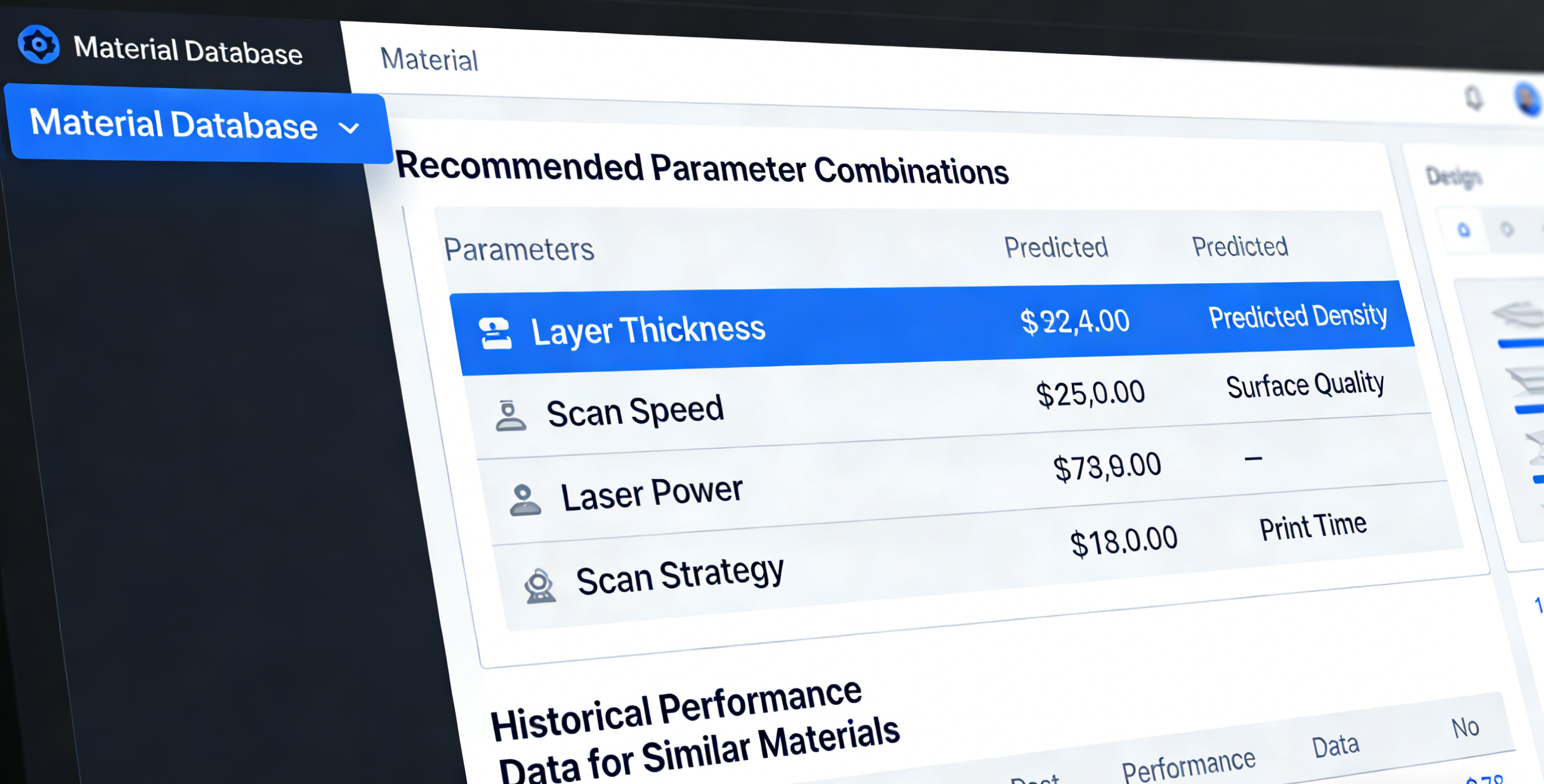
Intelligent additive manufacturing platforms further strengthen this characteristic. The system incorporates material databases, process parameter libraries, and simulation models, validating printability in real time during design. When designers create features beyond equipment capabilities, the system immediately alerts and suggests modifications. When designers select a material, the system automatically matches optimal process parameters. When designers complete models, the system automatically generates support structures, optimizes orientation, and estimates print time. Manufacturing preparation is completed during the design process.
Material Intelligence
The range of materials for additive manufacturing is rapidly expanding. Metals, polymers, ceramics, composites, each material has its unique process window. The same material can perform significantly differently across different equipment and parameters. Traditional process development relies on trial and error, determining optimal parameter combinations through extensive print tests.
Intelligent additive manufacturing platforms transform process development from trial and error to prediction. Machine learning models analyze historical print data, learning the complex relationships between materials, equipment, parameters, and outcomes. When printing new materials, the system predicts optimal parameter combinations based on existing data, dramatically reducing the number of tests required.
Material intelligence applies not only to process development but also to process control. During printing, sensors capture real time data on temperature fields, melt pool morphology, and stress distribution. The system continuously analyzes the relationship between this data and quality outcomes. When anomalies are detected, the system automatically adjusts process parameters to compensate for deviations and ensure part quality. The process is no longer a black box operation but a transparent, adjustable process.
Distributed Manufacturing
Additive manufacturing is reshaping the configuration of supply chains. Traditional manufacturing relies on centralized production, with parts produced in large factories in high volumes, then shipped to regional warehouses, and finally delivered to customers. This model requires substantial inventory and faces pressure from transportation costs and lead times.
Additive manufacturing makes distributed manufacturing possible. Digital part libraries replace physical inventory. Parts are printed where and when needed. Production locations expand from a few large factories to numerous local print centers, service providers, and even customer sites. Inventory transforms from finished goods to digital files, and lead times shrink from weeks to hours.
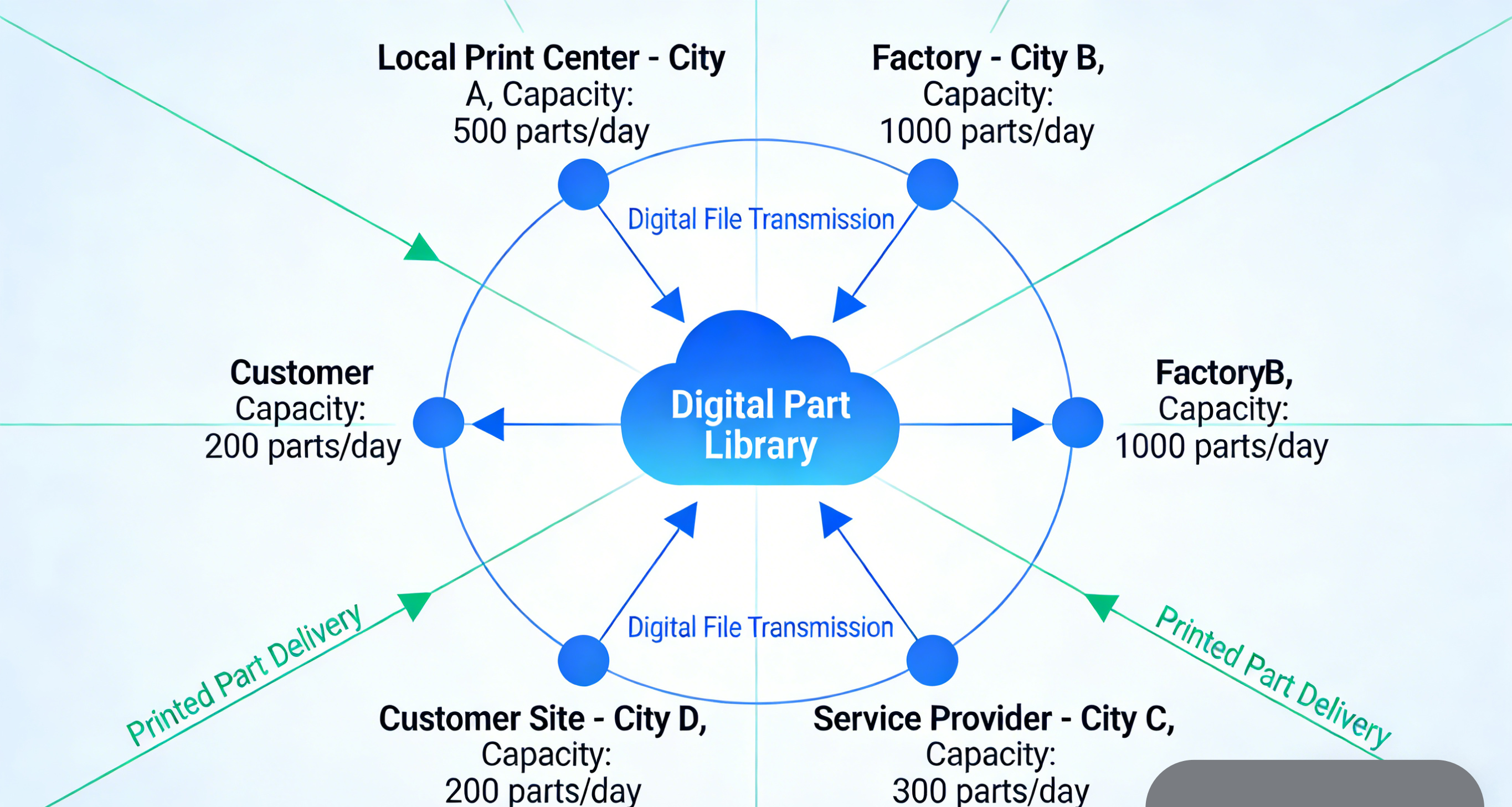
Intelligent additive manufacturing platforms serve as the orchestration layer for distributed manufacturing networks. The system manages digital part libraries, ensuring each part has the latest version, correct format, and complete process parameters. When customers place orders, the system dynamically assigns print tasks based on order location, capacity availability, and cost optimization. When a print node experiences failure, the system automatically transfers tasks to other nodes. Distributed manufacturing is no longer simple geographic dispersion but intelligent network coordination.
Value Anchors
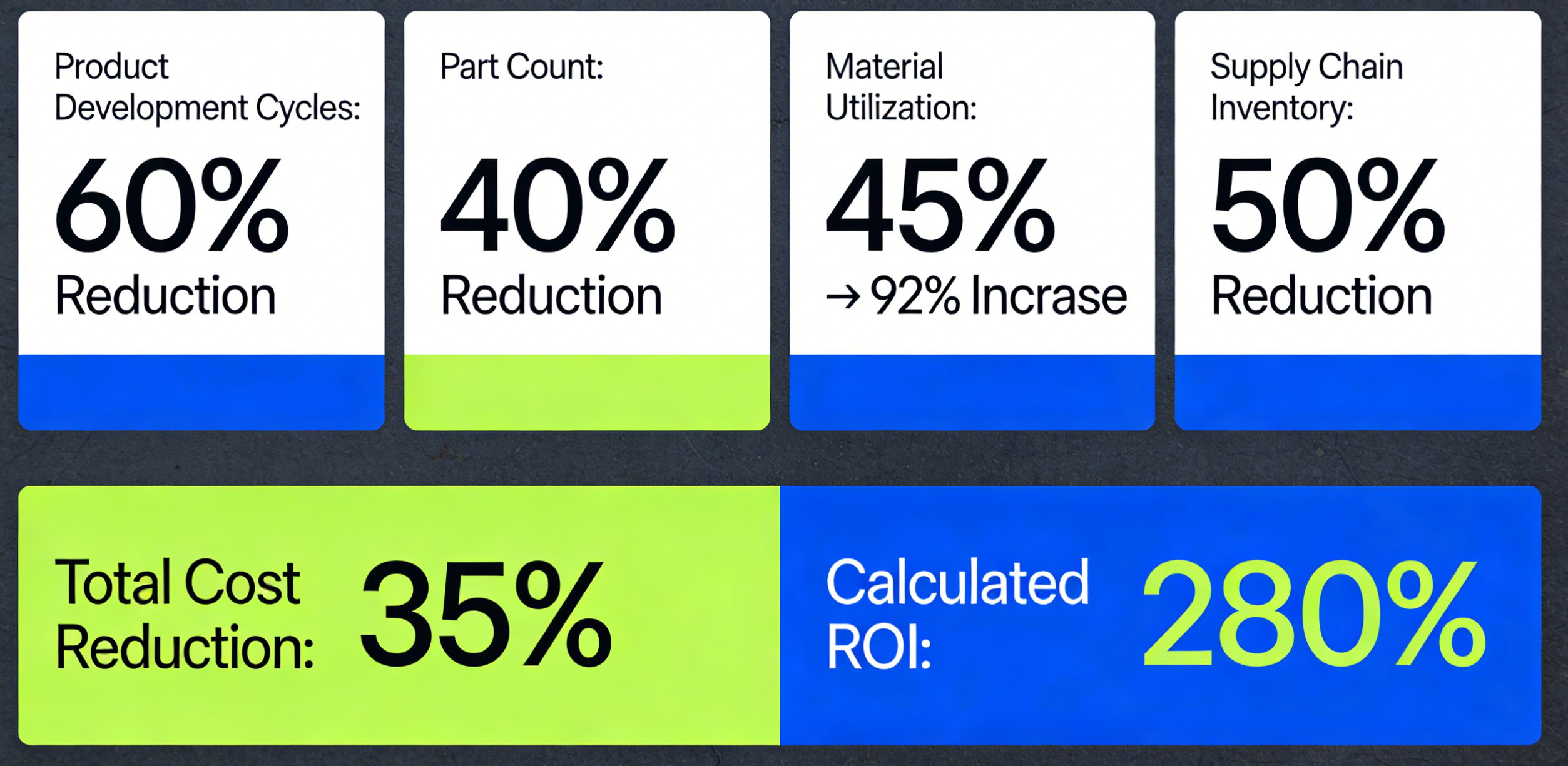
Enterprises that have deployed additive manufacturing platforms report measurable value across design, manufacturing, and supply chain.
Product development cycles shorten by 50% to 70%. Without molds and tooling, design validation cycles shorten dramatically and iteration speeds increase significantly.
Part count decreases by 30% to 50%. Multi part assemblies consolidate into single components, eliminating assembly errors and reducing inventory complexity.
Material utilization improves to over 90%. Traditional subtractive manufacturing often achieves less than 50% material utilization, while additive manufacturing approaches net shape forming with substantially reduced material waste.
Supply chain inventory decreases by 40% to 60%. Digital part libraries replace physical inventory, with spare parts printed on demand without requiring large stockpiles.
A New Manufacturing Paradigm
The true significance of additive manufacturing lies not in its ability to print complex shapes but in how it changes the fundamental logic of manufacturing. Traditional manufacturing is subtractive, removing material from stock to obtain parts. Additive manufacturing is additive, building parts layer by layer. Subtraction is constrained by tool accessibility, addition is not. The economics of subtraction depend on volume, the economics of addition are unaffected by volume.
The implications of this logical shift are profound. Design is no longer constrained by process limitations. Manufacturing is no longer constrained by volume thresholds. Supply chains are no longer constrained by inventory costs. Manufacturing is transitioning from a centralized, standardized, volume based paradigm to a distributed, personalized, agile paradigm.
In this new paradigm, the role of human engineers shifts from process executors to design innovators. The system handles the heavy work of process optimization, process control, and production scheduling. Engineers focus on functional innovation, material development, and application expansion. They are no longer followers of processes but explorers of manufacturing possibility.
This is not a story of replacement. It is a story of liberation.