Inventory Optimization: How to Reduce Shortages, Excess Stock, and Working Capital Pressure

Summary
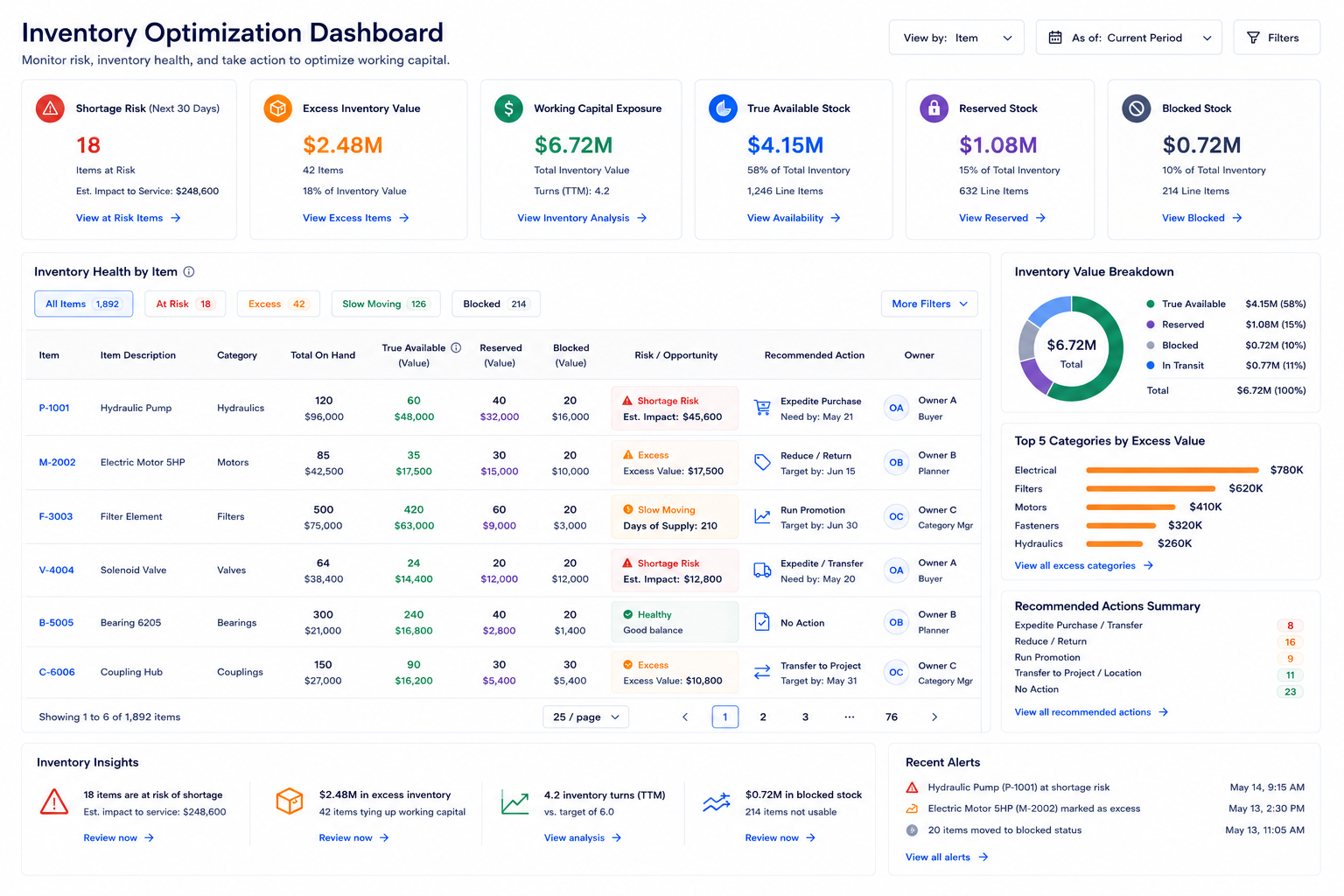
×Shortages and Excess Stock Grow When Inventory Is Visible but Not Controlled
A company can carry a high inventory value and still miss customer orders. An industrial distributor may have enough total stock across eight branches, yet lose urgent orders because the required item is in the wrong location, waiting for inspection, or already reserved. A manufacturer may hold weeks of material value and still lose 40 minutes in a shift because one low-cost component has not been cleared for the current work order.
The issue is not only whether stock exists. The issue is whether the stock is usable, located correctly, tied to confirmed demand, financially justified, and governed by rules before teams make promises or purchase more. Without that control, procurement buys extra to avoid shortages, finance sees more cash locked in inventory, and operations still complains that the right items are missing. The sharper question is: which stock protects demand, and which stock is only consuming cash? If the company cannot answer that before ordering, transferring, reserving, or promising inventory, shortage and excess will keep appearing together.
Industrial Distributors Need Promise-Ready Inventory
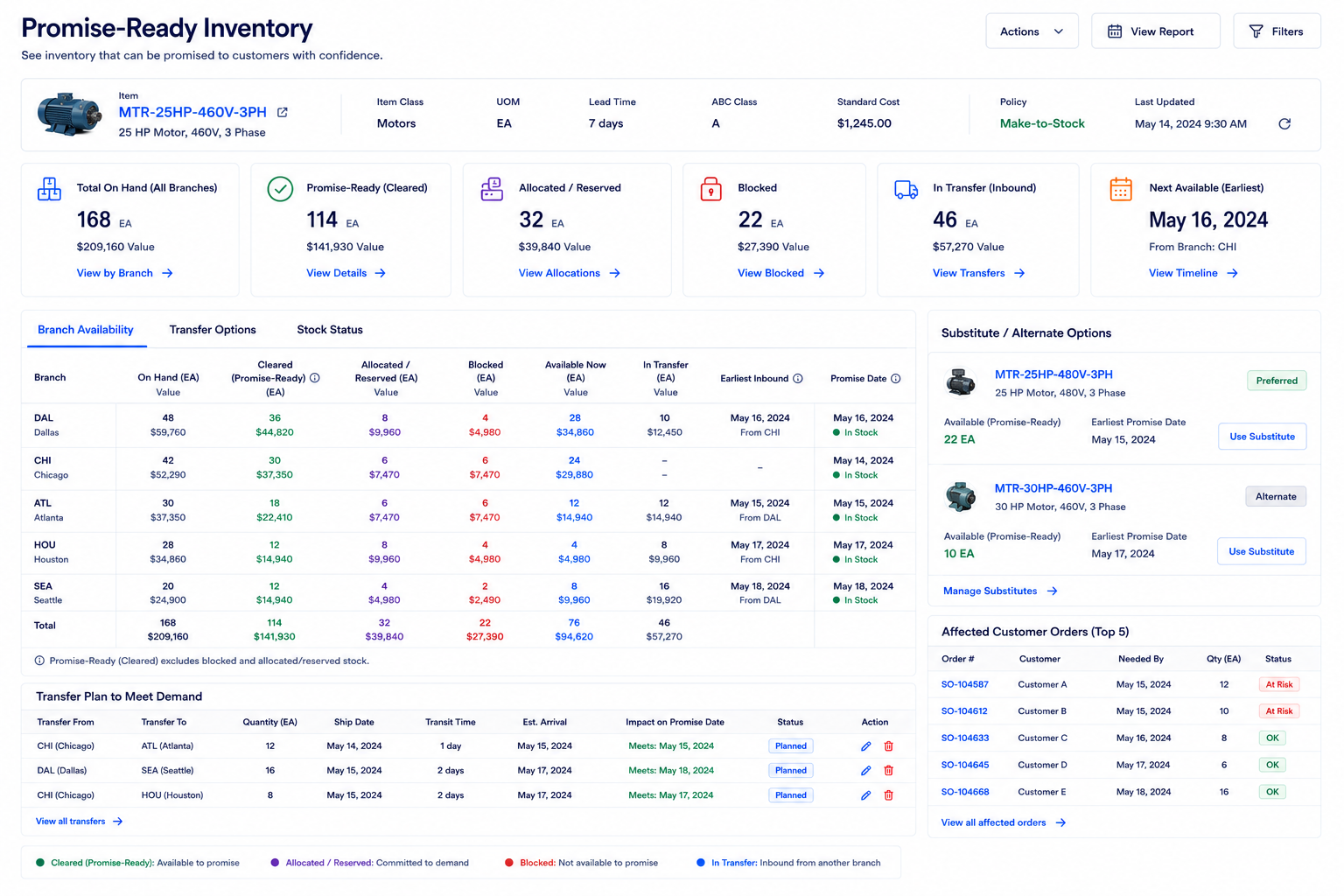
For an industrial distributor, the first inventory failure often happens at the customer promise. A bearing, valve, cable, fastener, or control component may appear in total inventory, but that does not mean it can support the delivery date. Stock in another branch, stock under inspection, stock already reserved, and stock available only through substitution must be treated differently.
A promise-ready inventory process should make the system decide what can be committed before sales confirms the order:
Block false promise: Do not allow a customer delivery date to be promised unless the stock is cleared, available, and located or transferable within the shipment window.
Check branch and transfer timing: Use another branch’s stock only when transfer time can still protect the customer date.
Remove restricted stock: Exclude inspection hold, damaged, returned, reserved, or blocked inventory from promise-ready quantity.
Control substitute offers: Require approval before a similar item is proposed as a replacement.
Show lost-order cause: Track whether missed demand came from shortage, wrong location, blocked stock, or late replenishment.
Manufacturers Need Material Clearance Before Release
In manufacturing, a shortage often starts before the stockout is visible. A production order may look ready because most materials are available, but one sensor has the wrong revision, one gasket is under quality hold, or one machined part is reserved for another order. The line does not need a warehouse total; it needs confirmation that the exact material can support the exact production run.
Material clearance should happen before production release, not after operators reach the line:
Match material to the production order: Confirm item, revision, quantity, lot, and required date against the BOM.
Hold restricted material: Prevent quality-hold, inspection-pending, reserved, or unissued stock from supporting production release.
Approve substitutes before use: Route alternate material to engineering or quality before it can be consumed.
Mark non-executable orders: Show supervisors which work orders cannot run because one required item is not cleared.
Prevent shift closure: Make it impossible to close a shift while a work order remains blocked by material that is visible but not cleared for production.
Service Teams Need Protected Critical Parts
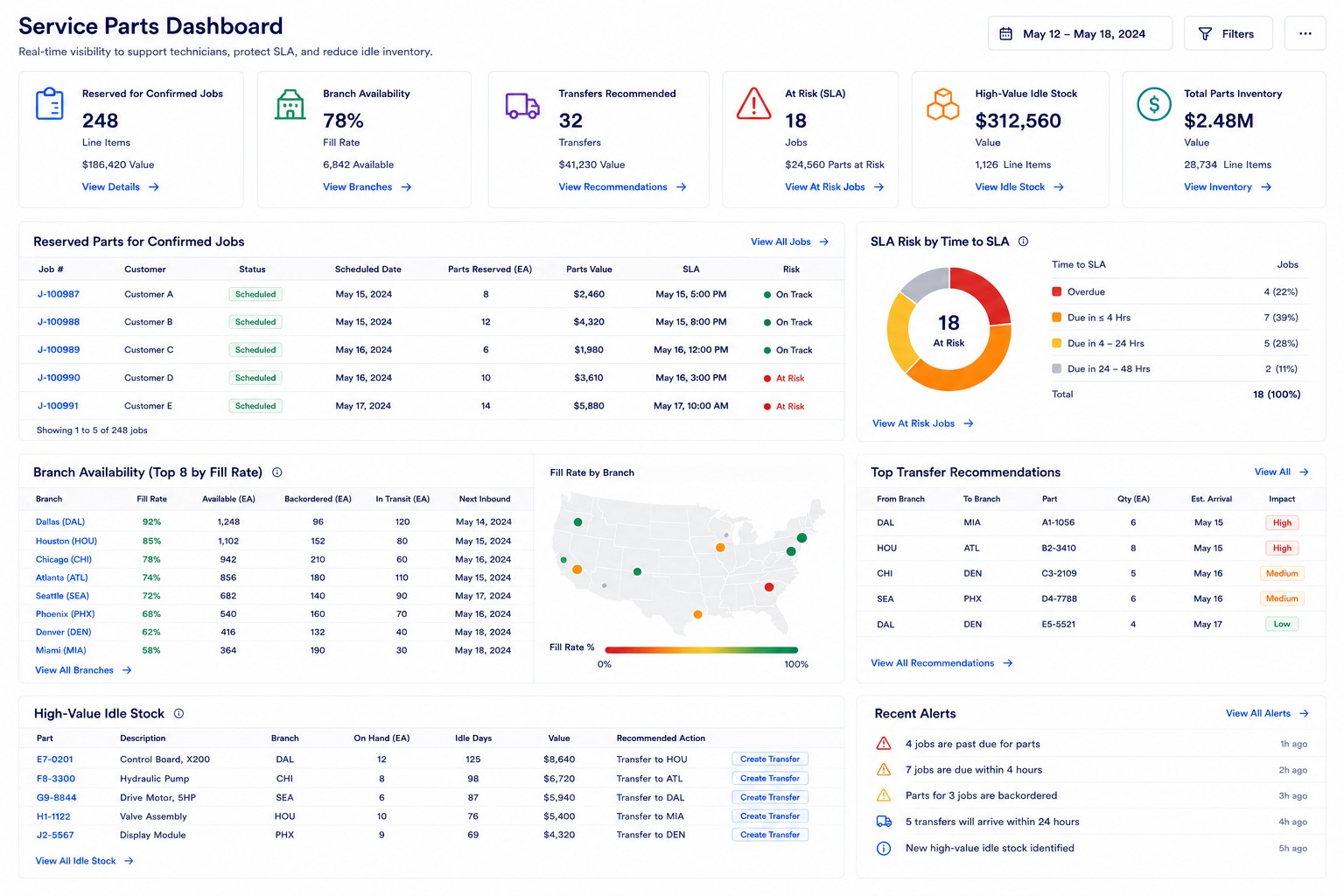
Equipment service companies often carry expensive spare parts and still miss response windows. The part may exist somewhere in the network, but not in the city, branch, vehicle, or service location where the technician needs it. This creates a costly pattern: high inventory value, urgent transfers, delayed service, and repeated pressure to stock more everywhere.
Critical service parts should be protected based on service impact, not treated as general stock:
Lock parts to confirmed service jobs: Reserve critical parts for scheduled work before they are consumed by lower-priority demand.
Escalate service-risk shortages: Alert the service owner when a missing part threatens a committed visit or SLA.
Transfer before purchasing: Check branch, service warehouse, or vehicle stock before creating a new purchase order.
Review high-value idle parts: Flag expensive parts with little or no recent use for transfer, reduction, or management review.
Stop duplicate stocking: Mark parts that are overstocked in one service location while another location is short.
Excess Stock Needs a Disposition Path
Excess inventory often looks reasonable item by item. A buyer ordered extra to avoid shortages. A branch kept more stock because demand was unstable. A product version changed, but old parts remained in the warehouse. These decisions can all make sense locally, while still creating company-wide working capital pressure.
The system should not only show slow-moving inventory. It should force a decision path for stock that no longer supports active demand:
Classify excess by cause: Separate no recent demand, forecast miss, canceled order, product replacement, minimum order quantity, duplicate branch stock, and reserved-but-not-consumed inventory.
Assign a disposition owner: Route each excess item to procurement, sales, warehouse, engineering, service, or finance for action.
Recommend the next action: Mark whether the item should be transferred, substituted, returned, discounted, written down, or retained as strategic stock.
Block repeat buying: Prevent new purchase approval for an item that already has unresolved excess in another location unless an override is approved.
Track cash exposure: Show the working capital tied to excess stock by item category, location, or business unit.
Replenishment Needs a Working-Capital Gate
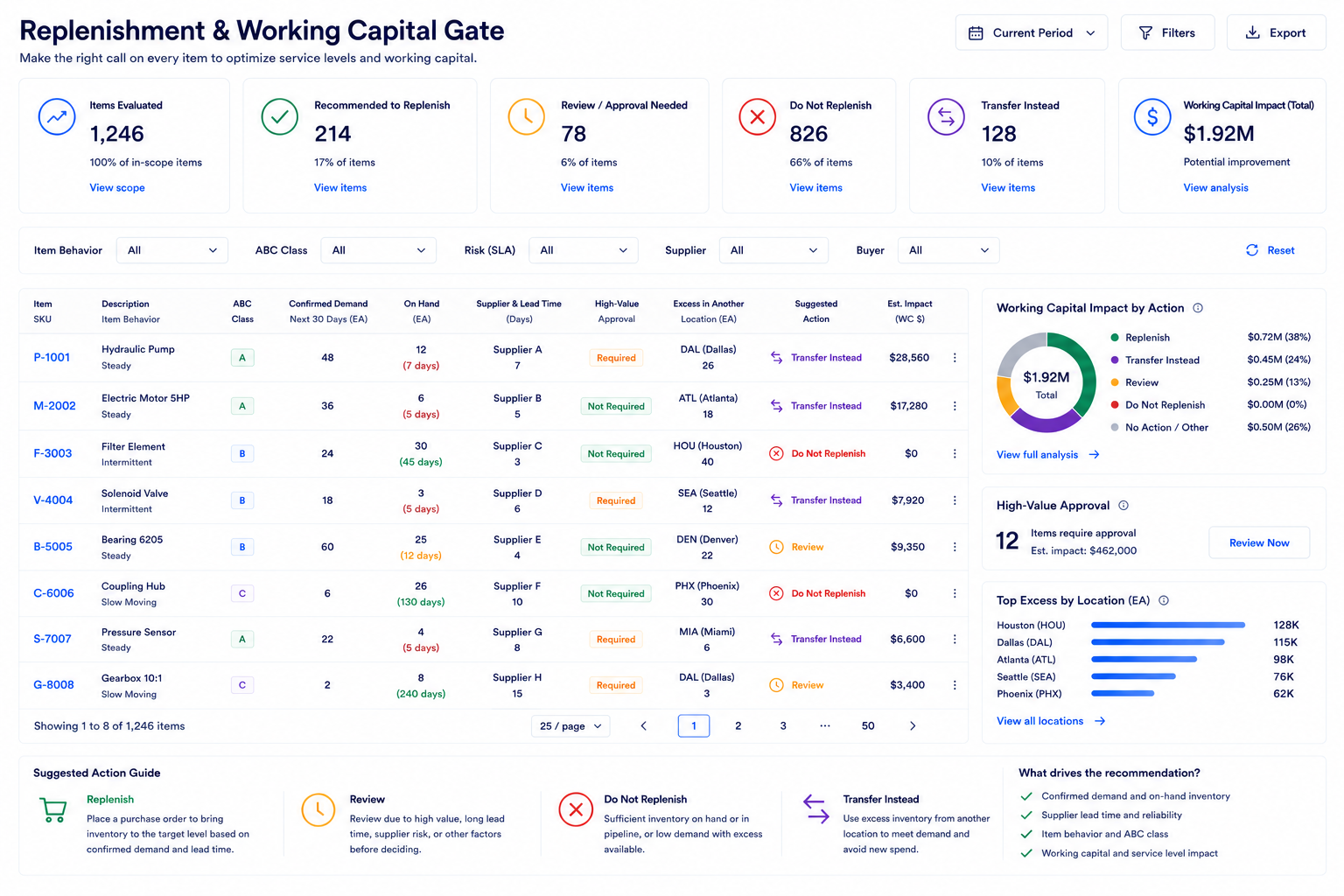
Replenishment creates both shortages and excess when the rule is too simple. Fast-moving consumables, high-value spare parts, seasonal products, customer-specific items, and critical production components should not follow the same reorder logic. Some items should be replenished quickly; others should require demand confirmation or approval before cash is committed.
A working-capital gate should review the purchase decision before inventory grows:
Separate demand types: Treat confirmed orders, forecast demand, production demand, service demand, and branch demand differently.
Apply item behavior rules: Use different logic for fast-moving, slow-moving, seasonal, critical, and customer-specific items.
Require approval for high-value slow movers: Stop expensive low-demand items from being reordered automatically.
Include supplier constraints: Use lead time, lead time variability, minimum order quantity, and package size before suggesting purchase.
Flag shortage-excess mismatch: Mark items that are short in one location and excessive in another before procurement buys more.
Management Needs an Inventory Capital-Risk View
Management does not need another dashboard that only shows inventory value, total quantity, turnover, and aging. Those metrics explain the past. Leaders need a view that shows where inventory is protecting operations, where it is failing demand, and where it is trapping working capital.
A useful inventory capital-risk view should answer:
Which customer orders or production runs are exposed to shortage?
Which stock is visible but not usable?
Which locations are short while another location holds excess?
Which high-value items have low or no recent demand?
Which replenishment suggestions require approval before cash is committed?
Which excess items need transfer, return, substitution, discounting, or write-down review?
Which owner must act today to protect service, output, delivery, or cash?
How Industry Software Supports Inventory Optimization Before Cash and Service Are Both at Risk
Industry Software helps companies connect shortage risk, excess stock, working capital exposure, replenishment rules, disposition workflows, and management dashboards into one practical inventory optimization process. By unifying these fragmented risk vectors into a single operational sequence, the platform helps supply chain leaders balance product availability against financial strain, converting chaotic warehouse data into a collaborative tool for cash-flow protection.
The platform helps operations and finance teams:
Start with the highest-pressure inventory issue: Deploy by module, such as true availability, shortage alerts, excess stock review, replenishment approval, or working-capital dashboards.
Configure rules around real inventory behavior: Set different logic for fast-moving items, slow-moving stock, critical spare parts, customer-specific items, high-value parts, and multi-location inventory.
Support cloud-based visibility: Keep branches, warehouses, plants, service teams, procurement, finance, and management working from updated inventory information.
Refine workflows quickly: Adjust availability rules, approval paths, transfer logic, replenishment thresholds, excess classifications, and dashboard views as operating conditions change.
Improve control with cost-effective deployment: Use scoped implementation and practical functionality to reduce shortages, control excess, and improve working capital discipline without a heavy system rollout.
Without this structure, inventory systems show stock value but do not control whether that value is useful. With Industry Software, companies can reduce avoidable shortages, expose excess earlier, protect cash, and turn inventory into a managed operating advantage. Inventory without control is just a cost; controlled inventory becomes a working-capital lever.