Modern ERP Software: Key Capabilities That Improve Business Operations

Summary
×Modern ERP Starts When Business Actions Update the Whole Operation
ERP becomes slow or unreliable when each department sees only its own part of the work. Procurement sees a purchase order. Warehouse sees stock movement. Finance sees invoices later. Project managers see margin pressure only after costs have already changed. Leadership sees the impact when the report is finally updated.
The business problem is not lack of data. The problem is that one action does not update every affected view at the right time. A supplier quote that is 12% above estimate is not only a purchasing issue. It is also a committed-cost issue, a margin issue, an approval issue, and sometimes a billing or customer conversation issue. The sharper question is: does one business action immediately change the views that depend on it? If not, ERP is still acting as a record system instead of an operating structure.
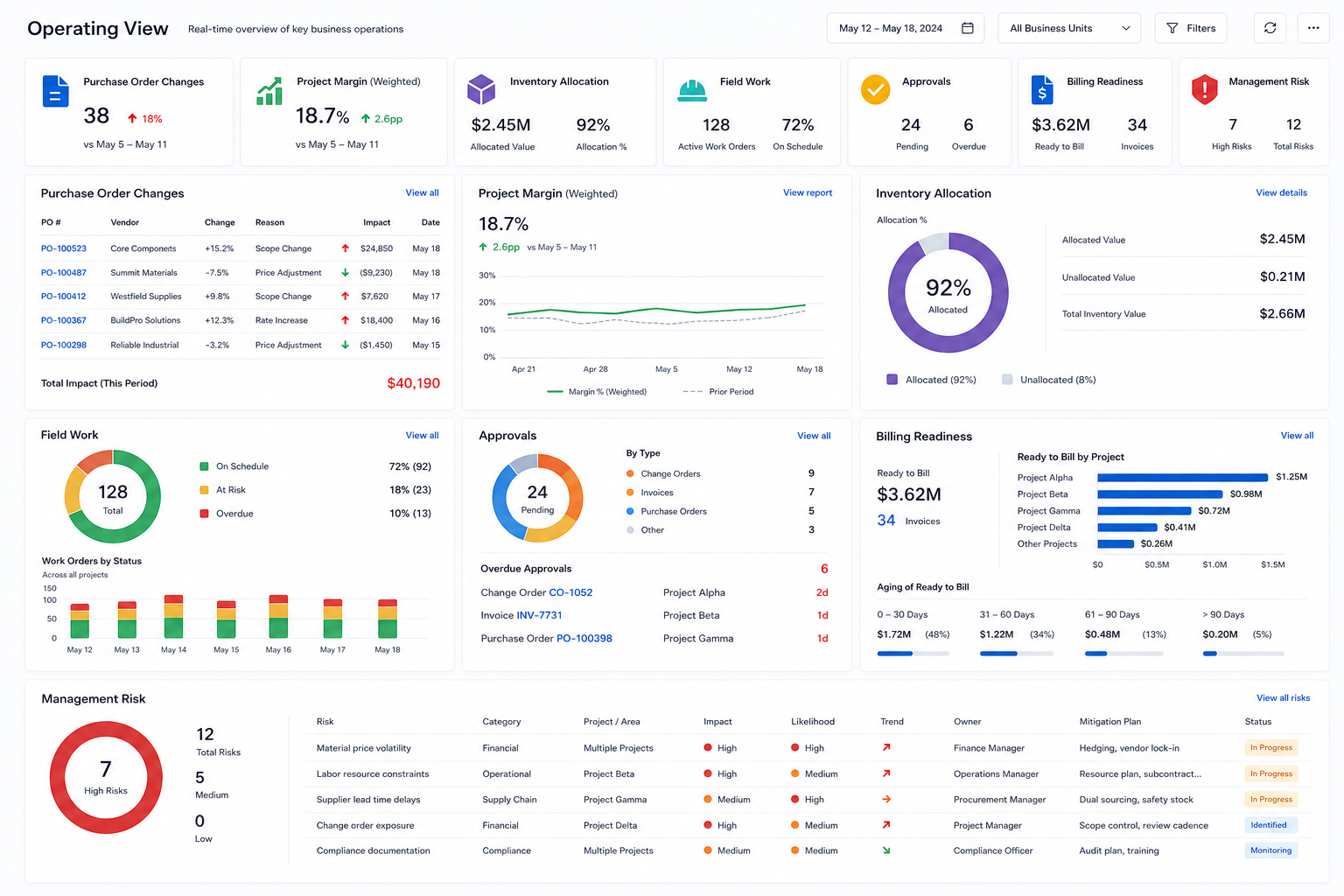
Project-Based Companies Need a Committed-Cost Gate
In construction, building systems, engineering service, and project-based operations, margin risk often appears before the invoice. A project can still look profitable while procurement is accepting a higher supplier quote, warehouse stock is reserved for another job, and field teams are already doing extra work that has not become an approved change order.
A committed-cost gate should make cost exposure visible before the company is financially locked in:
Block over-budget purchase release: Require approval when a supplier quote or purchase order exceeds the project budget line.
Update committed cost before invoice: Reflect approved purchase exposure in project margin before the supplier invoice arrives.
Connect cost to project structure: Link each purchase to the project, phase, cost code, work package, or customer commitment it affects.
Flag margin threshold breach: Alert the project manager and leadership when updated committed cost pushes margin below the approved level.
Hold billing confidence: Show when cost exposure, unapproved change orders, or material delays make billing milestones less reliable.
This prevents margin risk from appearing only after accounting catches up. Project managers can act while the purchase, change order, or customer decision is still controllable. Waiting for month-end financial reviews turns leadership into passive spectators of their own losses. Instead, executives need a live steering view that exposes cost leakage in real time, giving them the leverage to intervene before project profitability is permanently damaged.
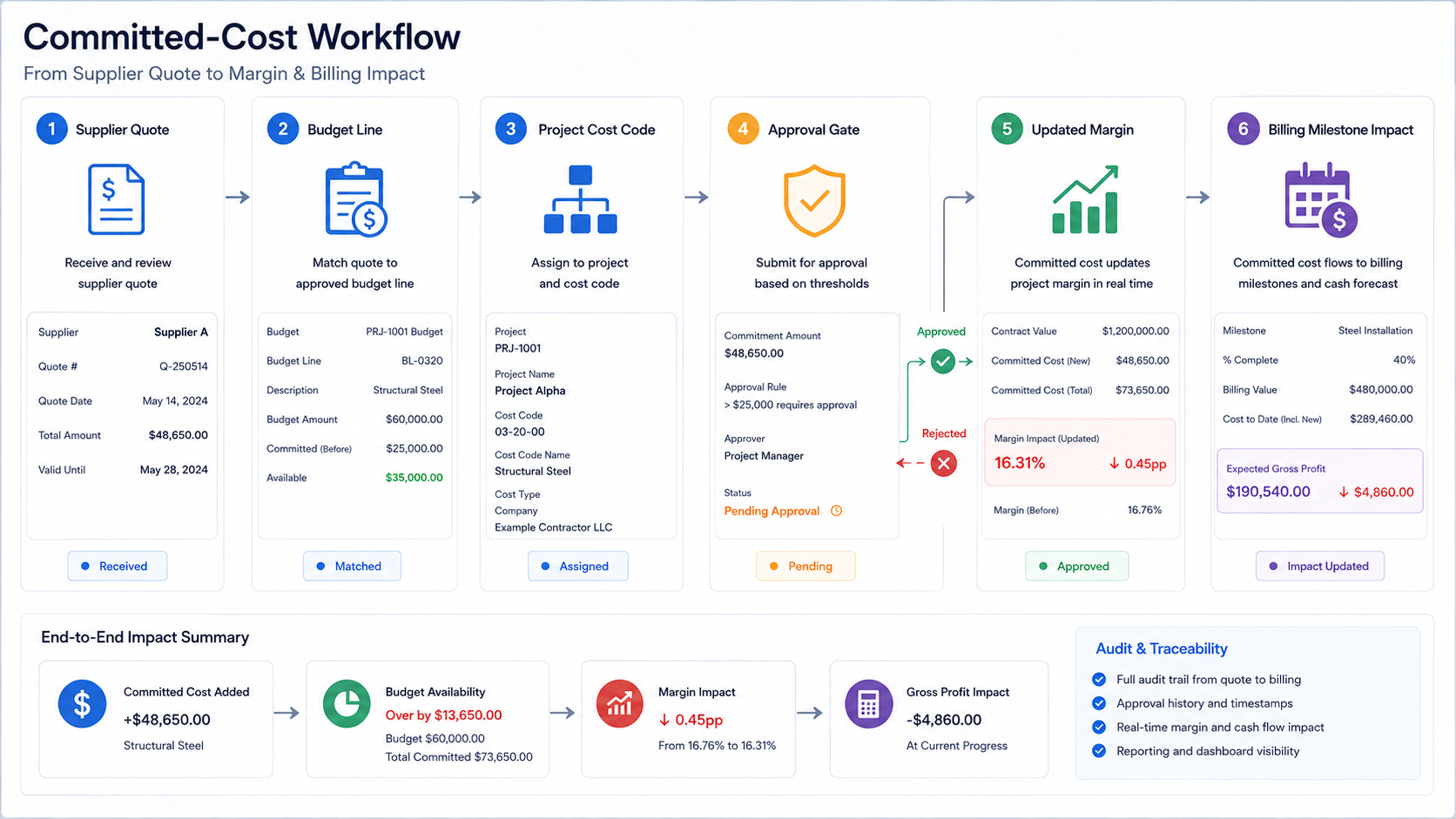
Field Work Needs a Change-Order Capture Gate
Field work creates some of the most expensive ERP blind spots. A site supervisor records extra labor, a technician installs additional material, or a client requests scope changes before the formal change order is approved. If those updates enter ERP late, finance sees cost after the work is done, and project managers lose the chance to protect margin.
A change-order capture gate should turn field activity into a controlled business signal:
Capture extra work at the source: Let field teams submit labor, materials, photos, notes, and client-requested work from the jobsite or service location.
Create potential change orders automatically: Convert approved field exceptions into pending change-order records instead of leaving them in messages or notes.
Block unapproved scope from disappearing: Keep extra work visible until it is approved, rejected, billed, or written off.
Link field cost to margin: Show how labor variance, material use, rework, or unapproved scope affects project profitability.
Prevent close without disposition: Make it impossible to close a project phase while material field exceptions remain without owner, approval status, or billing decision.
This changes field reporting from after-the-fact documentation into margin protection. The office does not wait for the end of the week to discover that the project has already absorbed unapproved work. Traditional site logs merely serve as a paper trail for overruns that have already occurred. To protect the bottom line, operations teams need instant visibility into unbilled labor and materials as they hit the ground, allowing them to stop scope creep in its tracks.
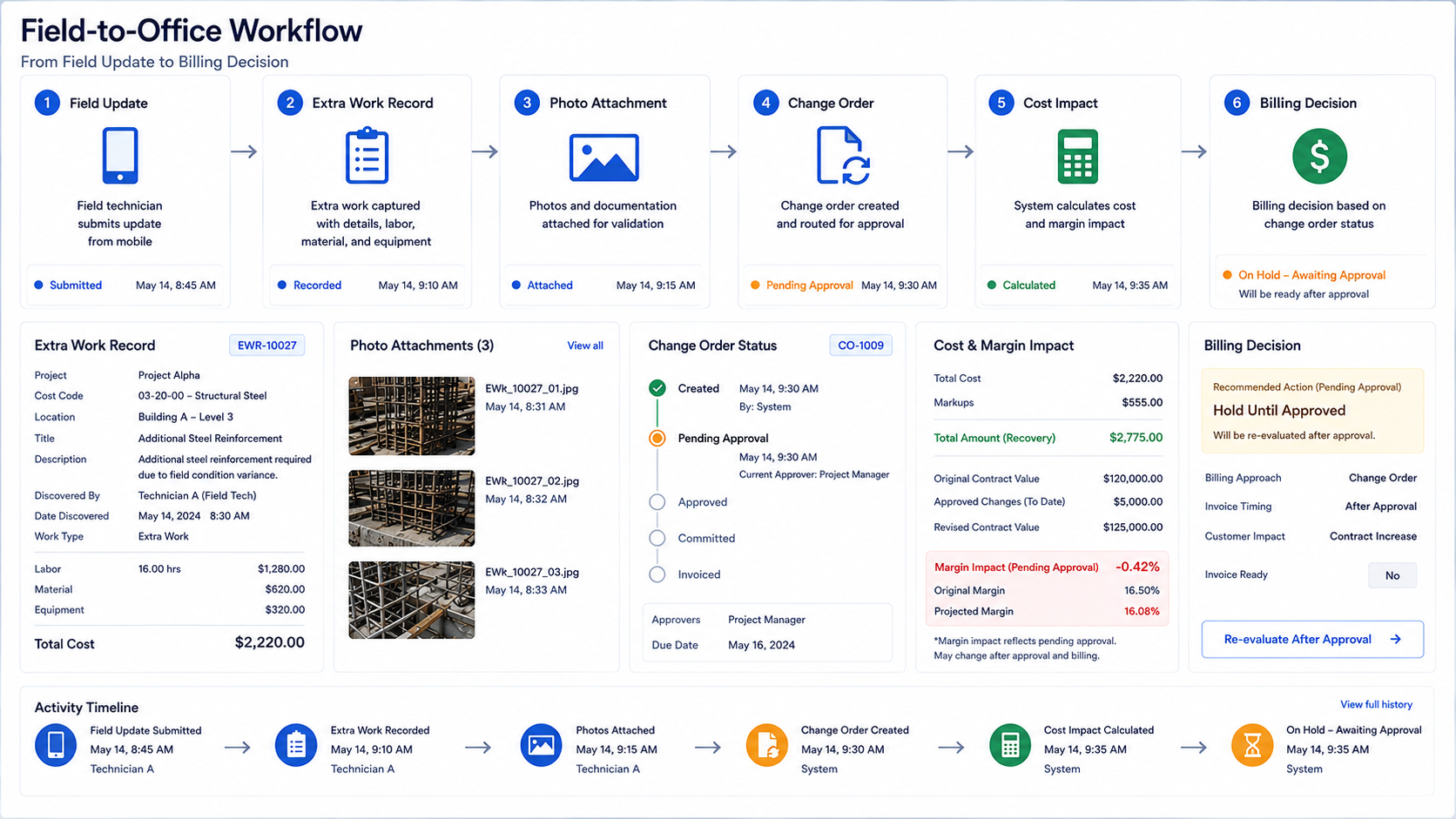
Inventory Allocation Needs Project and Order Discipline
Modern ERP becomes more useful when inventory allocation follows business priority, not just stock quantity. A company may show stock on hand, but that stock can be reserved for another project, under inspection, already promised to a customer, or needed for a higher-priority installation. If ERP treats all stock as generally available, teams make promises the business cannot keep.
Inventory allocation should be tied to the project, customer order, service job, or production need it supports:
Reserve stock against real demand: Link inventory to a project, order, work package, service task, or production requirement before it is consumed elsewhere.
Block unavailable stock from allocation: Exclude inspection hold, damaged, returned, reserved, or blocked stock from usable availability.
Show allocation conflicts: Alert teams when one item is needed by multiple projects, orders, or service commitments.
Recommend transfer or substitute review: Suggest cross-location transfer or approved substitute review before creating a new purchase.
Expose unused reservations: Ask owners to release stock that has been reserved but not consumed within the expected window.
This makes ERP inventory more than a warehouse count. It becomes a rule for protecting customer promises, project schedules, production readiness, and cash. Static ledger balances only tell companies what they own, but they offer no security for what they must deliver. Modern operations require an intelligent reservation logic that dynamically locks supply to its highest-value demand, ensuring that a physical part in the bin translates directly to an intact commitment.
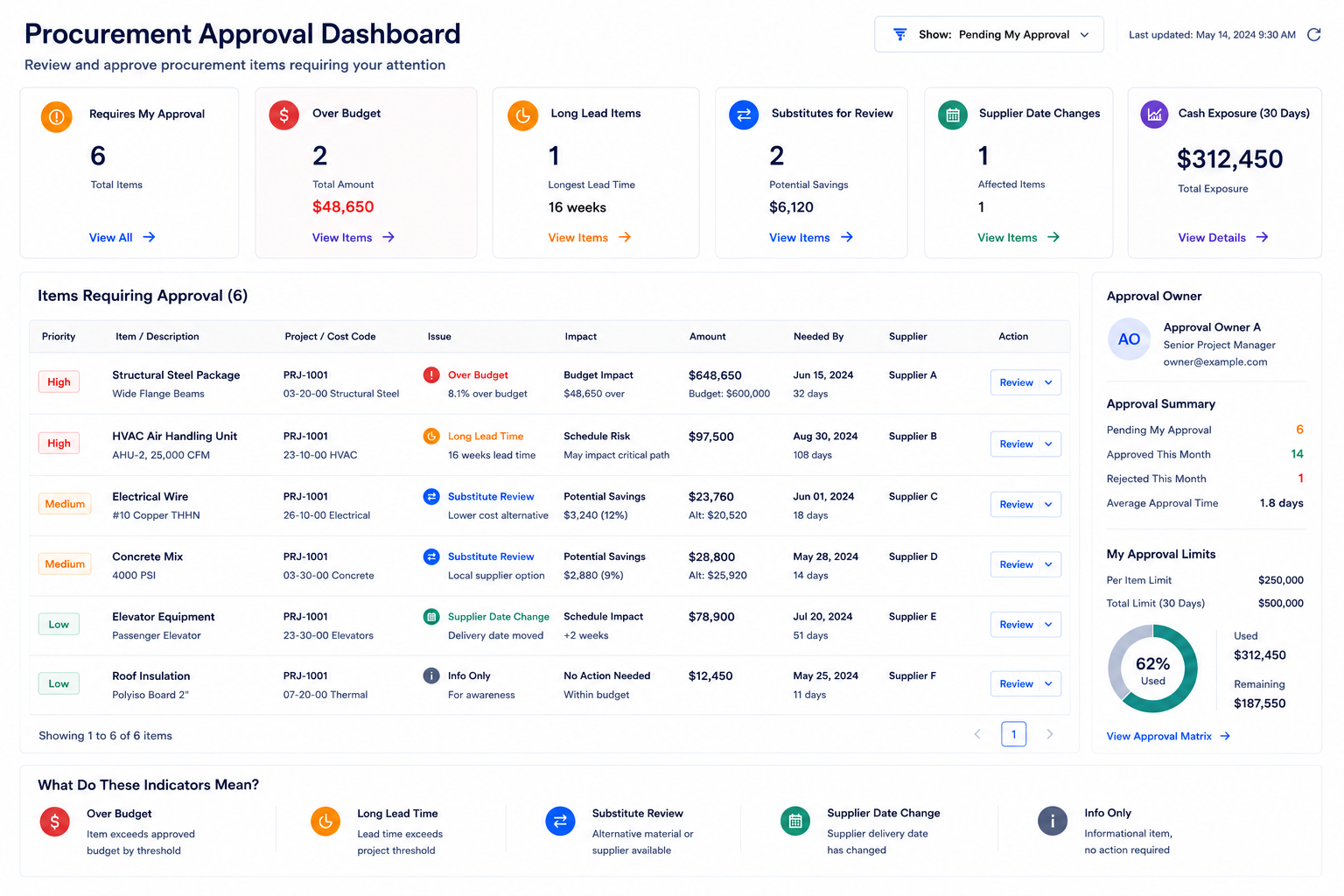
Procurement Needs Approval Rules That Match Business Risk
Procurement delays and cost overruns often start when approval logic is too simple. A low-value routine purchase should not follow the same path as a long-lead item that affects installation timing. A substitute material should not be approved the same way as a standard reorder. A supplier price increase should not wait until invoice posting to affect margin visibility.
Modern ERP should route purchasing decisions according to risk, value, timing, and operational impact:
Route over-budget purchases before commitment: Send budget exceptions to the right project, finance, or management approver before release.
Escalate long-lead risk: Alert project, scheduling, or operations teams when supplier timing affects installation, delivery, or billing.
Control substitute material approval: Require review when a replacement item affects specification, quality, warranty, or customer commitment.
Connect purchase timing to cash planning: Show when purchase commitments will affect near-term cash exposure.
Track supplier changes by impact: Mark whether a supplier price, date, or quantity change affects margin, schedule, stock availability, or customer promise.
This keeps purchasing from becoming a disconnected transaction. ERP gives procurement a clear path to buy, pause, escalate, or seek approval based on the real business impact. Standard purchase orders only confirm that an order was placed, but they fail to warn when supplier disruptions threaten a customer milestone. Procurement teams need an active tracking mechanism that ties every open delivery date to its actual downstream demand, allowing buyers to expedite or reroute shipments before production stalls.
Connected Systems Need Timing Rules, Not Just Integration
Many companies already use CRM, CAD, BIM, MES, QMS, WMS, accounting tools, scheduling platforms, or supplier portals. Modern ERP does not need to replace every system. It needs to make sure the right operational signal changes the right business view at the right time.
A material list from CAD or BIM should not sit outside procurement planning. A quality hold from QMS should not allow shipment or billing to continue as if the product were ready. A WMS inventory status change should affect sales promises, project allocation, or production readiness before a customer commitment is missed.
Useful ERP integration should do more than move data:
Convert CRM opportunities into structured ERP demand: Prepare project, quote, customer, item, budget, and approval logic before work begins.
Turn design material lists into procurement signals: Connect CAD or BIM material needs to budget, supplier lead time, and inventory availability.
Let quality holds block business movement: Stop shipment, billing, or customer release when QMS status prevents completion.
Use warehouse status in customer promises: Let WMS stock status change available-to-promise and allocation decisions.
Connect production progress to delivery readiness: Let MES updates change inventory, fulfillment, and customer delivery views.
Management Needs an Operating-Risk View
Management does not need another dashboard that only lists revenue, cost, inventory value, open purchase orders, overdue invoices, or project progress. Those numbers explain what has happened. Leaders need to see which operating risks need action now.
A useful ERP operating-risk view should answer:
Which projects are losing margin, and what caused the movement?
Which purchase orders exceed budget before release?
Which materials are reserved but not used?
Which change orders are performed but not approved?
Which field teams show abnormal labor or material variance?
Which inventory shortages will affect delivery, installation, or production?
Which billing milestones are blocked by incomplete work or missing approval?
Which business unit, location, project type, or customer carries the highest current risk?
Without this view, leaders chase explanations after the report changes. With it, they can see which cost, schedule, inventory, approval, or billing issue needs action before the business result is damaged. Retroactive explanations do not restore lost capital or missed deadlines. High-performing organizations shift from analyzing what went wrong to mastering the leading indicators, ensuring that management intervention always outpaces market volatility and execution failures.
How Industry Software Supports Modern ERP Operations Before Risk Reaches Reporting
Industry Software helps companies turn ERP into a practical operating structure by connecting procurement, inventory, projects, field work, finance, approvals, integrations, and management dashboards around shared business rules. Deploying technology without alignment merely accelerates chaos across different departments. True operational excellence occurs when disjointed applications are woven into a single cohesive ecosystem, allowing information to flow seamlessly and ensuring every team executes against identical priorities.
The platform helps organizations:
Start with the most painful workflow: Deploy by module, such as procurement control, project costing, inventory allocation, field reporting, billing coordination, service operations, or executive dashboards.
Configure rules around real operations: Adjust approval paths, cost codes, project phases, inventory allocation, field workflows, alerts, billing rules, and reporting views around the way the business actually works.
Support cloud-based usage: Keep office teams, field teams, warehouses, plants, service locations, finance, and management working from updated operational information.
Connect systems without forcing replacement: Integrate CRM, CAD/BIM, MES, QMS, WMS, accounting, scheduling, or supplier systems where timing and business logic matter.
Refine workflows quickly: Update exception rules, approval thresholds, role views, alerts, and dashboards as teams identify operational gaps.
Improve control with cost-effective deployment: Use practical scope, modular rollout, and focused implementation support to improve ERP value without unnecessary disruption.
Without this structure, ERP records what happened after departments have already made separate decisions. With Industry Software, companies can control the moments where cost, inventory, field work, approvals, billing, and management reporting begin to change. Modern ERP without operating rules is only a database; ERP with shared logic becomes a scalable business foundation.