CPQ and Digital Quoting: How to Generate Faster Quotes from Drawings

Summary
×Quoting Slows Down When Drawings Become Manual Interpretation
For custom manufacturers, fabricators, industrial equipment suppliers, and project-based product companies, quoting often begins with a drawing. The customer sends a CAD file, PDF drawing, marked-up specification, or assembly reference, and the sales or engineering team must turn it into material needs, process steps, machine time, labor assumptions, supplier costs, margin, and delivery date. The delay does not come from one large task; it comes from many small interpretation decisions that sit outside the quoting system.
A drawing can look complete but still leave the quoting team exposed. The revision may be unclear, material grade may not match current purchasing options, tolerances may require special processing, or the drawing may reference components that need supplier confirmation. If these assumptions stay in emails, spreadsheets, or engineer notes, the quote can move fast but still carry risk. The sharper question is: is this quote based on a controlled drawing, approved assumptions, and current cost logic? If not, faster quoting only means the business reaches the customer faster with a price it may not be able to protect.
Drawing Intake Needs Revision Control
A quote should not begin from an unclear drawing version. In metal fabrication, machining, industrial components, or custom assemblies, one small revision can change material thickness, hole pattern, coating requirement, purchased part, tolerance, or packaging method. If the wrong revision is quoted, the company may win the job and lose margin during production.
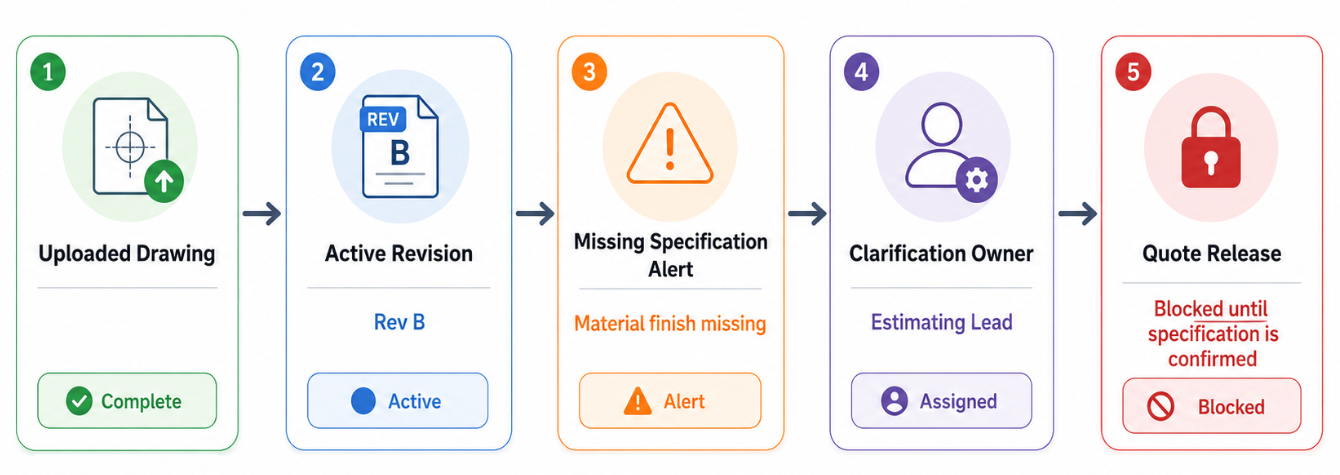
A drawing intake workflow should make the drawing status clear before pricing begins:
Lock the active revision: Make one drawing version the quoting source of record before estimating starts.
Flag missing specifications: Mark missing material grade, tolerance, finish, quantity, delivery requirement, or customer note before quote generation.
Capture customer changes: Keep marked-up drawings, revised files, and clarification notes connected to the same quote record.
Block uncontrolled quoting: Prevent a quote from being released when drawing revision, quantity, or required specification is unresolved.
Assign clarification owner: Route missing information to sales, engineering, estimating, or the customer-facing owner.
Manufacturing Quotes Need Material and Routing Logic
A drawing is not a price until it becomes a manufacturing plan. A sheet metal part may require cutting, bending, welding, finishing, inspection, and packing. A machined part may require material sourcing, CNC time, setup time, tooling, coating, and quality checks. If quoting relies on memory or manual spreadsheet formulas, two estimators can price the same drawing differently.
CPQ and digital quoting software should connect drawing interpretation with standard costing logic:
Map material to current cost: Use approved material categories, supplier pricing, scrap factors, and availability rules before calculating price.
Apply routing templates: Convert part type, geometry, process family, or product category into standard operation steps.
Include setup and labor assumptions: Separate setup time, run time, finishing, inspection, handling, and packaging.
Flag special processing: Escalate tight tolerance, unusual finish, heat treatment, certification, or outside service requirements.
Preserve estimate logic: Keep material, routing, labor, and supplier assumptions attached to the quote.
Supplier-Dependent Items Need Cost Confirmation Before Release
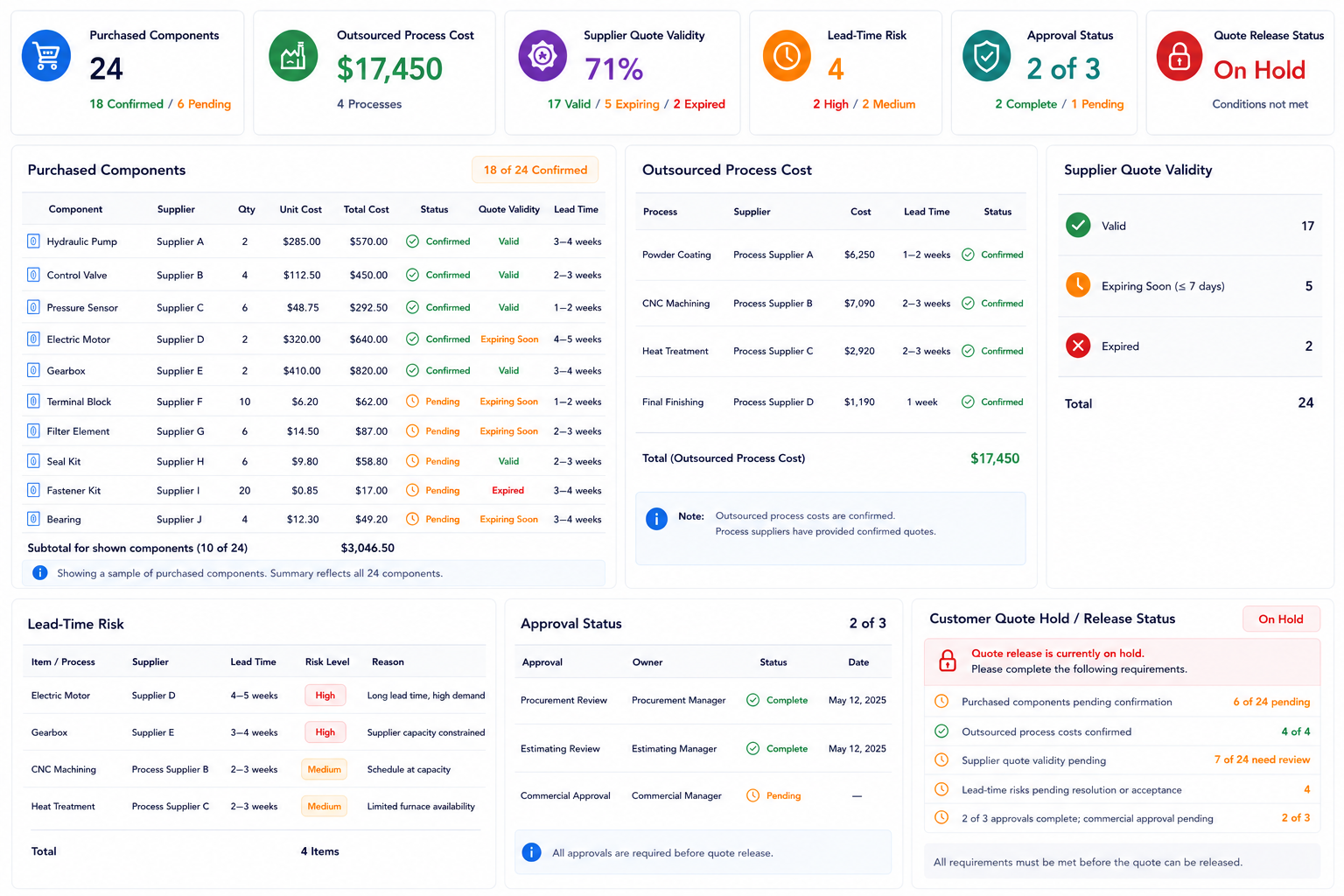
Many drawing-based quotes include purchased parts, outsourced coating, special materials, tooling, freight, or subcontracted processes. The quoting team may want to respond quickly, but if supplier-dependent costs are not confirmed, the company can underprice the job or promise a delivery date that purchasing cannot support.
A supplier-cost gate should protect the quote before it reaches the customer:
Mark supplier-dependent lines: Identify purchased parts, outsourced processes, special materials, and long-lead items inside the quote.
Hold uncertain cost assumptions: Prevent final quote release when a supplier cost is expired, missing, or outside allowed variance.
Compare supplier lead time to requested delivery: Show whether supplier timing supports the promised quote date.
Escalate high-impact changes: Route large supplier price increases or lead-time risks to sales, estimating, or management.
Keep supplier evidence: Attach supplier quote, validity period, lead time, and cost basis to the customer quote.
This helps the company quote fast without hiding purchasing risk. The quote reflects what can be sourced, not only what can be estimated. By aligning pricing directly with real-world material availability, the business eliminates the gap between cost assumptions and procurement realities, ensuring that every rapid proposal remains both competitive and fully executable.
Margin and Approval Rules Should Work Before the Quote Is Sent
Fast quoting creates risk when price approval happens after the customer has already seen the number. A sales team may adjust margin to win a job, an estimator may include an assumption that requires management approval, or engineering may add a special process without pricing the risk fully. If approval happens too late, the company either delays the customer response or sends a weak quote.
A margin approval gate should enforce commercial discipline before quote release:
Set margin thresholds by product type: Apply different approval levels for standard parts, custom assemblies, rush orders, and high-risk jobs.
Flag low-margin exceptions: Route quotes below approved margin to sales leadership, finance, or management before release.
Control discount authority: Prevent unauthorized price changes from bypassing approval rules.
Show cost drivers: Explain whether margin pressure comes from material, labor, supplier cost, tooling, freight, or delivery risk.
Block quote release: Make it impossible to send a quote with unresolved margin exception, missing cost support, or expired supplier input.
This protects speed and profitability at the same time. Teams can respond quickly because approval rules are already inside the quoting workflow. By embedding these guardrails directly into the daily process, the business removes the need for manual checkpoints, allowing the organization to accelerate its sales velocity without sacrificing margin oversight.
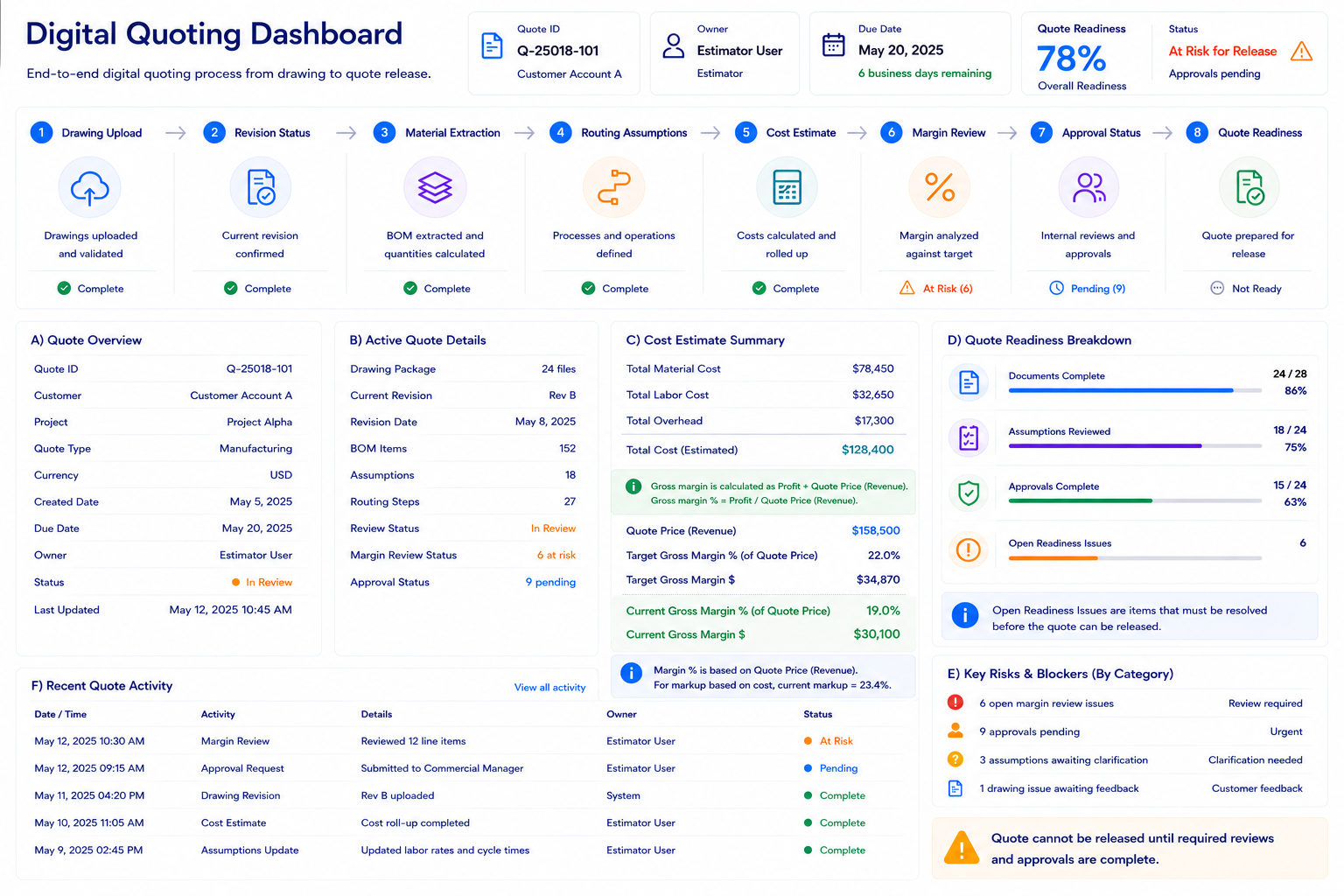
Management Needs a Quote-Readiness View
Management does not need only a count of open quotes. Leaders need to know which quotes are ready to send, which are blocked, which carry margin risk, and which assumptions could affect delivery or profitability. Quote volume alone does not show whether the business is building reliable revenue.
A useful quote-readiness view should answer:
Which drawings are waiting for revision or specification clarification?
Which quotes are blocked by supplier cost, lead time, or special process review?
Which quotes fall below approved margin thresholds?
Which estimations rely on unsupported material, labor, or routing assumptions?
Which high-value quotes need management approval today?
Which quotes are delayed because engineering, sales, or purchasing has not acted?
Which quote types convert well but create production or margin risk later?
Without this view, teams chase quote status across emails and spreadsheets. With it, managers can see which quote needs clarification, costing, approval, repricing, or release before the customer response window is missed. Eliminating this fragmented tracking ensures that pipeline bottlenecks are identified instantly, allowing leadership to steer attention toward urgent deals and secure the business before competitors can react.
How Industry Software Supports Faster Quoting From Drawings
Industry Software helps companies connect drawing intake, revision control, material costing, routing logic, supplier confirmation, margin rules, approvals, and quote-readiness dashboards into one practical digital quoting workflow. By anchoring these diverse stages into a unified digital pipeline, the business prevents critical technical and financial details from slipping through the cracks, seamlessly converting complex front-end engineering data into reliable, rapid commercial commitments.
The platform helps sales, estimating, engineering, and management teams:
Start with the highest-impact quoting bottleneck: Deploy by module, such as drawing intake, cost estimation, supplier-cost control, approval routing, or quote dashboards.
Configure rules around real products: Set different quoting logic for fabricated parts, machined components, assemblies, service parts, project-based items, and custom orders.
Support cloud-based collaboration: Keep sales, engineering, estimating, purchasing, finance, and management working from updated quote records and drawing information.
Refine workflows quickly: Adjust approval thresholds, costing formulas, routing templates, drawing fields, quote formats, and dashboard views as the business learns from live quoting.
Improve speed with cost-effective deployment: Use practical scope, modular rollout, and focused support to shorten quote cycles without forcing a heavy system project.
Without this structure, fast quoting depends on individual experience, spreadsheet discipline, and manual follow-up. With Industry Software, companies can quote from drawings faster while protecting cost assumptions, margin, approvals, and delivery confidence. A faster quote is useful only when the business can stand behind it; controlled digital quoting makes speed commercially reliable.