ASC 842 Lease Accounting Software: How to Simplify Lease Compliance and Reporting

Summary
×Lease Reporting Risk Starts Before the Schedule Is Calculated
ASC 842 requires lessees to recognize assets and liabilities related to lease rights and obligations, with recognition required for lease terms of more than 12 months. That makes lease completeness, timing, assumptions, and evidence part of the reporting control process, not just back-office documentation.
The structural problem is that lease activity often happens in operations before finance controls it. A store opens, a warehouse lease is extended, an equipment lease is returned early, or a clinic agreement is amended. If those events reach finance through email, shared folders, or close-period reminders, the company has already lost control of the reporting workflow.
The cost is not just late entries. A finance team that discovers three unreviewed amendments during close can lose two hours of reconciliation time, miss a payment change, or carry an unsupported assumption into reported balances. Each of those gaps becomes a post-close adjustment, audit follow-up, or partner question.
Retail Expansion Needs a Pre-Activation Lease Gate
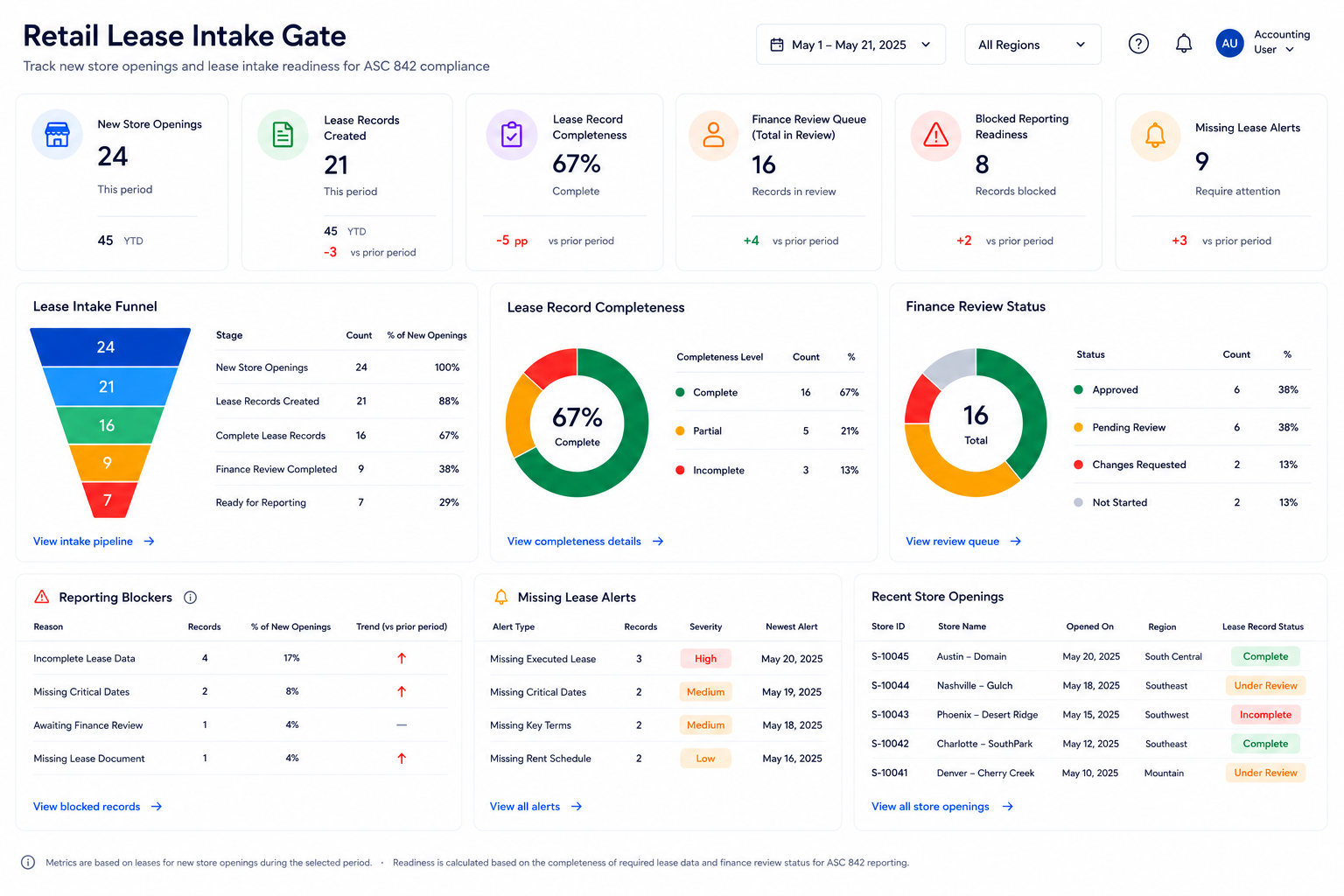
A retail chain opens 10 new stores near quarter-end, but 3 signed leases do not enter the lease population before reporting starts. The risk is not just missing paperwork. The risk is that operating locations become active before finance has confirmed reporting completeness.
A pre-activation lease gate should enforce:
Block reporting readiness: Keep each new store lease out of ready-for-reporting status until the signed contract, commencement date, lease term, payment schedule, and approval owner are complete.
Flag missing lease records: Compare new store openings against the lease population and mark missing lease entries before close.
Route finance review: Assign accounting review before the lease moves into ASC 842 reporting schedules.
Lock incomplete records: Prevent incomplete lease records from generating final schedules or disclosure support.
Show intake status: Display which leases are complete, incomplete, rejected, or waiting for finance review.
Logistics Leases Need an Amendment Hold Gate
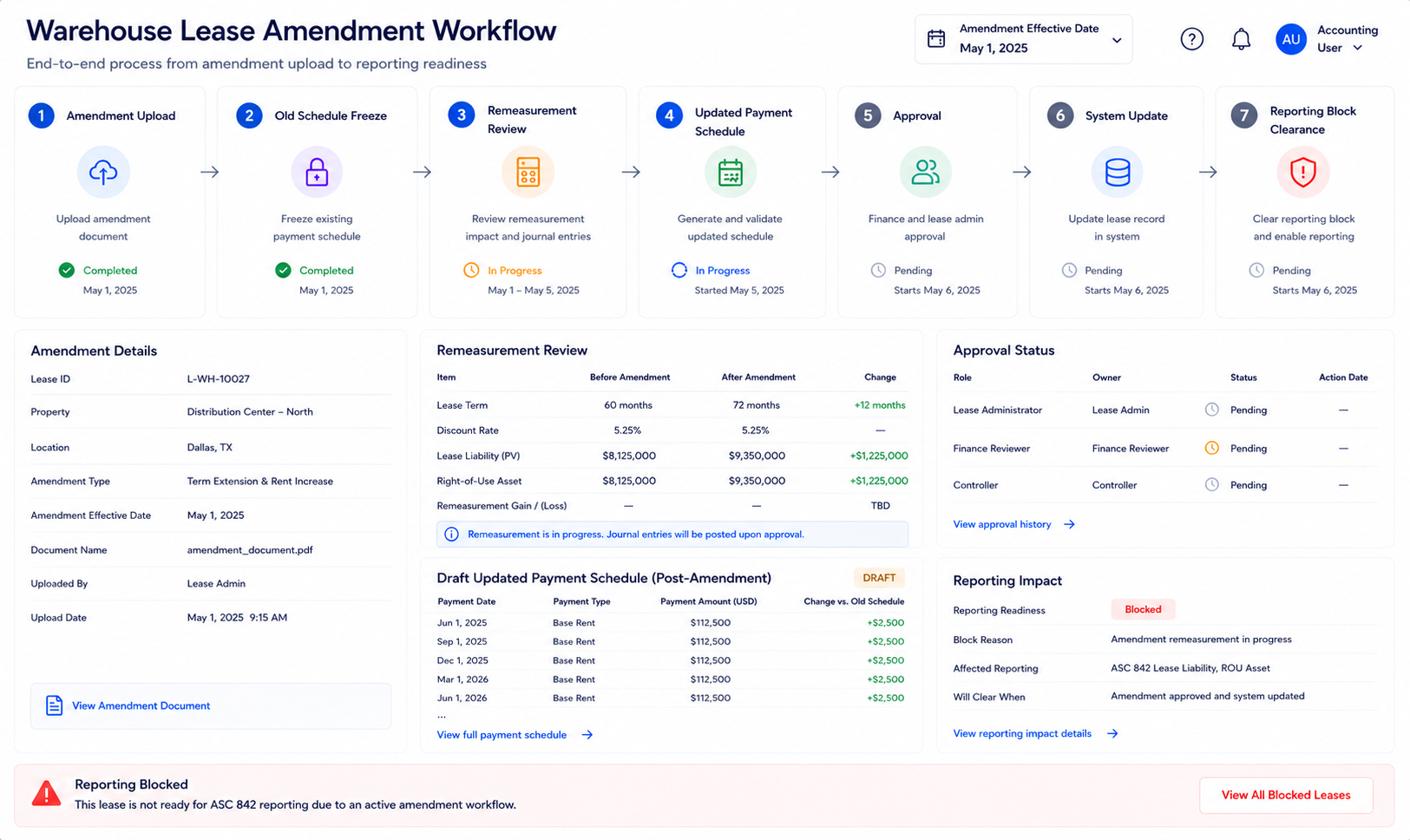
A logistics company extends a warehouse lease before peak season, changing future payment timing and lease term before finance updates the reporting schedule. The operational decision may be practical, but the reporting impact must not flow into balances without review.
An amendment hold gate should enforce:
Freeze the old schedule: Stop the previous payment schedule from flowing into reporting after an amendment is uploaded.
Trigger accounting review: Route the extension to finance for lease term, payment, and remeasurement review.
Compare changed terms: Show the difference between original terms and amended terms before schedule update.
Block final reporting: Keep the amended lease out of final reporting until review and approval are complete.
Record review evidence: Preserve the amendment, reviewer, decision time, and updated schedule support.
Manufacturing Equipment Needs an Early-Return Remeasurement Hold
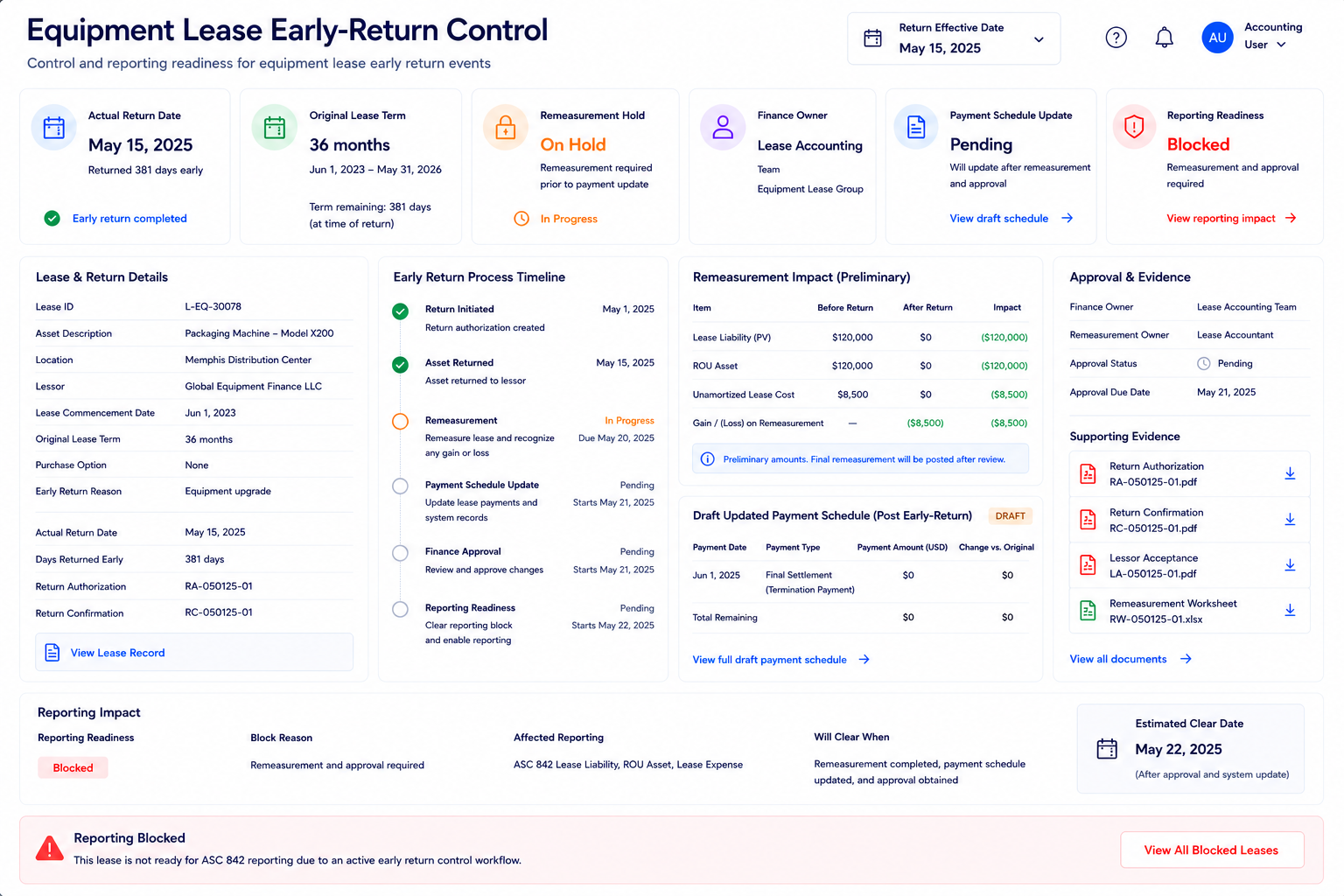
A manufacturer returns a leased production machine 6 months early, but the original lease schedule continues to appear in the reporting file. The asset is no longer in use, but the accounting schedule still behaves as if nothing changed. This disconnect creates an artificial inflation of current operating liabilities on the balance sheet, distorting the company’s true financial position. Consequently, decision-makers are left relying on inaccurate data that masks available budget space and complicates short-term cash flow forecasting.
An early-return remeasurement hold should enforce:
Mark early return: Record the actual return date and compare it with the original lease term.
Hold the lease schedule: Stop the original payment schedule from rolling forward until finance completes remeasurement review.
Notify finance owner: Assign review to the responsible accounting owner when early return is recorded.
Update asset status: Connect the returned equipment status with the lease record, payment schedule, and reporting impact.
Require approval evidence: Keep the lease under hold until termination or remeasurement support is attached.
Healthcare Locations Need a Renewal Control Gate
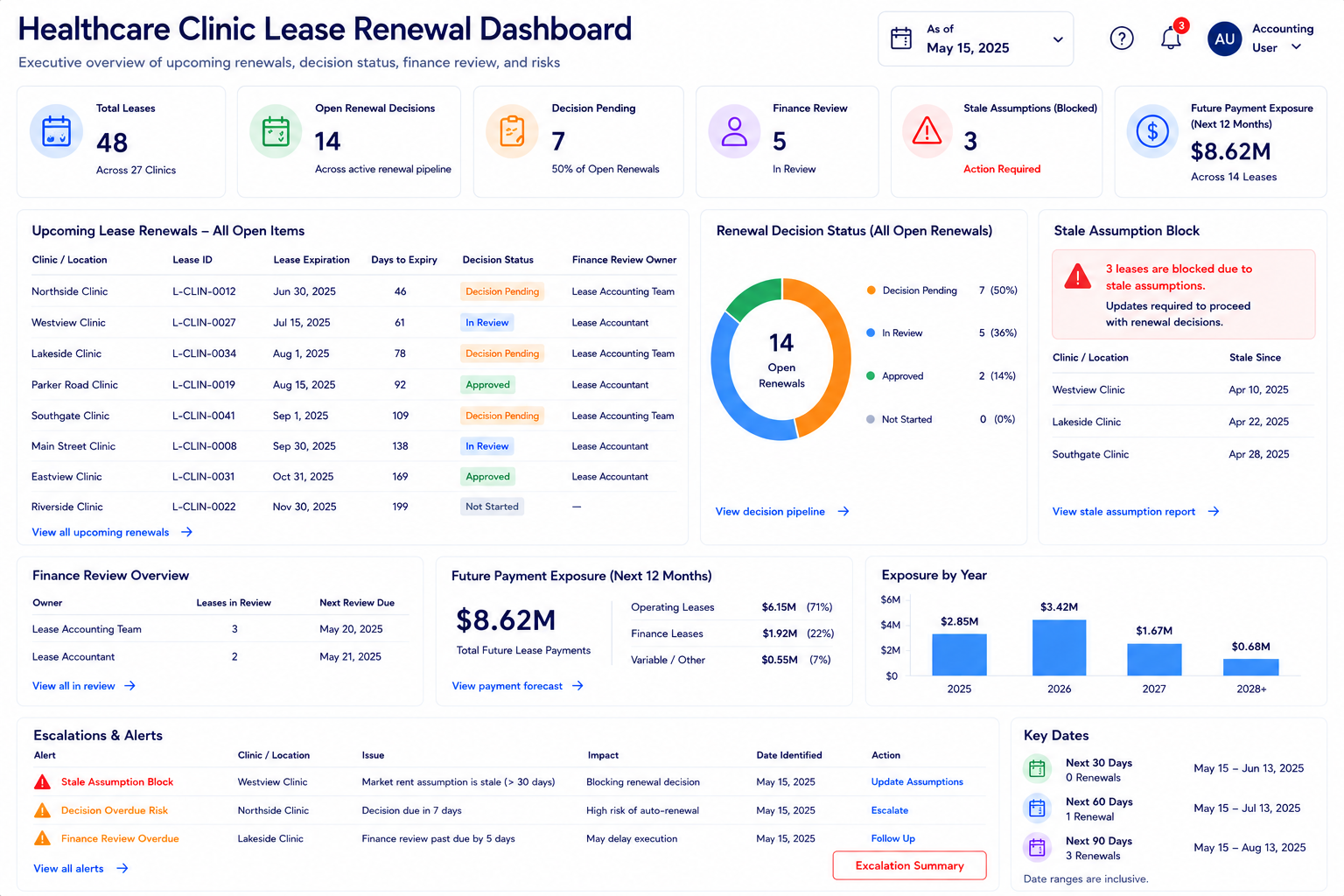
A healthcare group operates multiple clinics, and several facility leases approach renewal while local teams negotiate terms outside the finance workflow. The reporting risk forms before the renewal is signed, because old assumptions can roll forward even when the business decision has already changed.
A renewal control gate should enforce:
Trigger renewal review: Start finance review before the renewal decision date, not after the agreement is signed.
Separate renewal outcomes: Mark each lease as renew, terminate, renegotiate, or pending decision.
Block stale assumptions: Prevent old lease terms from rolling into the next reporting period after the renewal deadline passes.
Route missing decisions: Escalate leases with no renewal decision to finance and operations owners.
Update exposure view: Reflect renewal status in future payment forecasts and management reporting.
Audit Support Needs a Live Evidence File
A finance team completes lease calculations, but the contract, amendment, discount rate support, approval note, and schedule version sit in different files when auditors ask for evidence. The number may be calculated, but the support path is still weak. Professional ASC 842 guidance continues to address practical application questions, which reinforces the need for structured documentation and review processes.
A live evidence file should enforce:
Attach source evidence: Link contracts, amendments, payment terms, and approval records directly to the lease record.
Track assumption changes: Record which assumption changed, who approved it, and which schedule uses it.
Flag evidence gaps: Mark missing contract files, missing approvals, or unsupported assumptions before audit requests arrive.
Connect schedules to balances: Link lease liability, right-of-use asset schedules, journal support, and disclosure outputs.
Export audit package: Generate support by lease, entity, location, period, or balance category.
Block period close: Prevent the reporting period from being marked as closed while any lease record has missing contract, missing approval, or unsupported assumption without an assigned owner and review date.
This is the difference between rebuilding audit support after the numbers are prepared and maintaining reporting evidence throughout the lease lifecycle. Without this control, finance searches for evidence after the close deadline; with it, the system enforces evidence readiness before reporting can be completed.
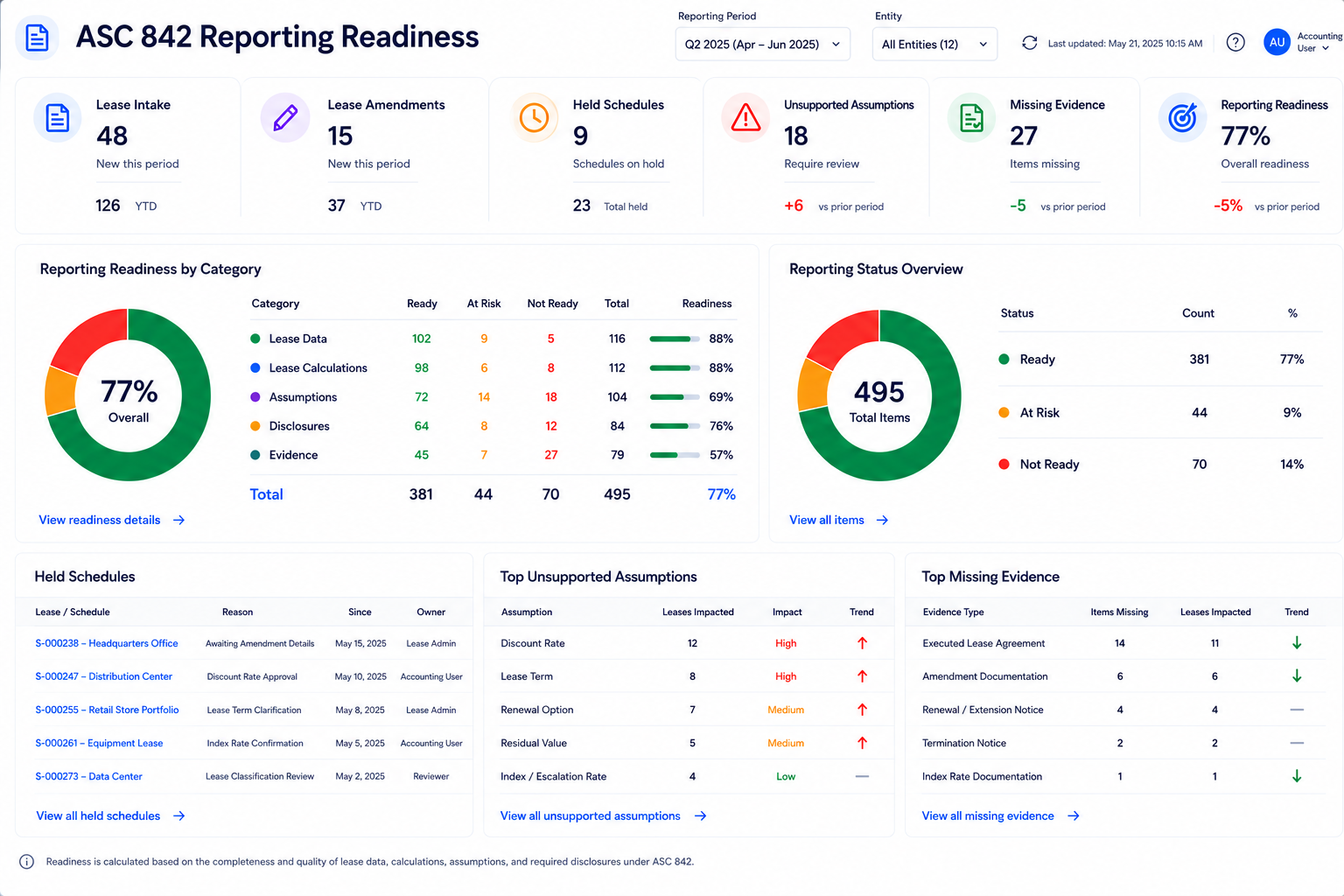
Management Needs a Lease Reporting Readiness View
Before the next lease audit, project managers can look to their analytics tools for clarity. A management dashboard should not start with total lease count. It should show which lease records are not ready for reporting, why they are not ready, and which business owner must act. By prioritizing data exceptions and immediate bottlenecks over high-level metrics, the dashboard transforms from a passive summary into an active operational tool. This ensures that data integrity issues are intercepted and resolved by the responsible parties before they can distort financial reporting.
A useful lease reporting readiness view should answer:
Lease population gaps: Which leases are missing from the reporting population?
Incomplete records: Which leases lack contract, commencement date, payment schedule, or review owner?
Unreviewed amendments: Which amendments have not completed accounting review?
Held schedules: Which payment schedules are frozen because of amendment, renewal, or early return?
Unsupported assumptions: Which balances depend on assumptions without approval evidence?
Audit gaps: Which leases lack evidence needed for audit support?
Renewal exposure: Which upcoming renewals affect future payment forecasts or reporting readiness?
How Industry Software Supports Lease Compliance Before Reporting
Industry Software helps companies connect lease intake, amendments, remeasurement holds, renewal reviews, assumption support, payment schedules, audit evidence, and reporting readiness into one lease accounting workflow. Linking these separate administrative steps reduces the friction of manual data handoffs and helps teams keep track of continuous lifecycle changes. This alignment allows financial records to update alongside real-world modifications, supporting a more routine approach to audit preparation.
The platform helps finance teams:
Use modular customization: Start with the highest-risk workflow, such as lease intake, amendment review, renewal control, audit evidence, or reporting dashboards.
Work through cloud-based access: Keep finance, procurement, legal, operations, and local teams working from updated lease records.
Configure control rules: Define activation gates, amendment triggers, remeasurement holds, review ownership, and missing evidence alerts.
Rely on dedicated service and ongoing support: Support implementation, workflow setup, process adjustment, and post-launch optimization.
Improve control with cost-effective implementation: Use scoped deployment and practical functionality to improve ASC 842 control without a heavy system rollout.
By turning lease accounting from after-the-fact reconciliation into controlled reporting readiness, Industry Software helps finance teams reduce close pressure and strengthen ASC 842 compliance. Without this structure, ASC 842 compliance depends on manual follow-up, spreadsheet reconciliation, and after-the-fact evidence collection. With Industry Software, lease events are controlled before they affect reporting, and finance teams can close with fewer surprises and stronger audit support.