Results Snapshot
Enabled core warehouse, project requisition, material transfer, return, and stocktaking workflows to go live within 4–6 weeks, reducing materials status confirmation time by 32%
Shortened inventory discrepancy investigation time by 38%, giving teams clearer visibility into material, tool, and reusable asset status, ownership, and movement history
Connected the WMS with ERP / financial workflows through real-time APIs to support budget validation, project cost allocation, and material issue record generation during requisition and outbound confirmation
Supported offline buffering, exception recovery, tool lifecycle management, and loss-rate tracking, reducing project cost reconciliation preparation time by 45%
Customer Profile
The customer is a construction contractor delivering commercial building, infrastructure, and multi-site construction projects. Daily operations involve central warehouse management, jobsites, supplier deliveries, project requisitions, tool check-out and return, material returns, and project cost accounting. Steel components, piping, electrical materials, hardware items, generators, drills, measuring devices, consumables, and high-value reusable materials need to move continuously between warehouses, jobsites, and project teams.
As more projects ran in parallel, materials management became more complex. Some materials had arrived but were still pending inspection, some had already been reserved for specific projects, some tools were in use on jobsites, and some returned materials needed inspection before they could be reassigned. The customer needed more than an inventory list; it needed a Warehouse Management System that could connect warehouse execution, jobsite operations, purchasing plans, ERP / financial workflows, and project cost control.
Industry Software began the project by reviewing the customer’s material movement, project requisition, tool lifecycle, and cost allocation workflows. The project team included supplier receiving, inbound inspection, location management, project reservation, jobsite requisition, cross-project transfer, return inspection, tool inspection, repair and disposal, loss records, offline recovery, and ERP / financial system integration in the solution design. The goal was not to improve warehouse tasks in isolation, but to connect material status, field execution, budget control, and project cost management in one operating chain.

Business Challenge
The customer’s main challenge was not simply a shortage of stock. It was the lack of clarity around material status, project ownership, budget impact, and cost allocation. Once materials moved from suppliers to the warehouse and then to jobsites, they passed through receiving, inspection, reservation, budget validation, requisition, transfer, return, and loss scenarios.
Coordination between the central warehouse and jobsites created additional pressure. Project managers needed to know whether critical materials would arrive on schedule, warehouse teams needed to understand which requisitions had higher priority, and purchasing teams needed to plan replenishment based on actual consumption and project reservations. When information was scattered across spreadsheets, messages, and manual confirmation, material shortages, duplicate purchasing, jobsite waiting time, and after-the-fact data entry became more likely.
Financial closure created a deeper problem. If the WMS only reduced inventory quantity after materials were issued, while the ERP / financial system still required manual posting later, project costs would lag behind field consumption. For a construction contractor, that delay can allow over-budget requisitions to continue and make it difficult for finance leaders to detect cost exceptions at the moment of issue.
Unstable jobsite connectivity created another practical challenge. Some jobsites rely on weak mobile signals, temporary networks, or work areas where connectivity can drop for short periods. If the system blocks every operation during a timeout, field work may stop unnecessarily; if it releases every offline transaction without control, budget validation and auditability may be weakened.
Tools, equipment, and high-value reusable materials created another layer of complexity. Generators, drills, measuring devices, specialized tools, and reusable materials cannot be managed only by check-out and return quantity. They also require serial numbers, custodians, assigned projects, inspection validity, repair status, damage reasons, disposal outcomes, and normal loss rates.
System Design for Project-Based Operations
The customer needed a warehouse management foundation that could support project-based operations. Industry Software worked with the customer to focus the implementation on four priorities: improving material visibility, standardizing project requisition and transfer workflows, connecting ERP / financial workflows, and managing the lifecycle of tools and reusable materials. This direction allowed the WMS to support not only the warehouse, but also project execution, budget control, cost accounting, and management review.
During the workflow review, the project team found that several operating rules had not been fully standardized. These included which materials could be transferred between projects, which requisitions required project manager approval, which returned materials needed inspection before being made available again, which tools had to be tracked by serial number, and which losses should be assigned to project cost. Industry Software translated these business decisions into system rules, creating a clearer path for material and tool movement.
The project also placed strong emphasis on real-time cost control. Material issue should not only reduce quantity inside a warehouse system, and it should not wait for an overnight batch file before entering the financial workflow. For business events that affect budget and project cost, Industry Software used real-time API integration so requisitions, budget validation, outbound confirmation, and project cost records could work together in the operating flow.
At the same time, the integration was not designed as a single rigid mode. Industry Software worked with the customer to define offline operating strategies by material value, operational risk, approval status, and project impact. Critical materials, high-value tools, and requests that may create over-budget risk require ERP / financial validation before release, while low-risk consumables, pre-approved urgent issues, or temporary network interruption scenarios can enter offline buffering with pending synchronization records and exception review tasks.
Key Solution Areas
Industry Software configured and deployed a cloud-based Warehouse Management System that centralized central warehouse operations, jobsite materials, material requisitions, cross-project transfers, returns, tool check-out and return, stocktaking, and cost data synchronization in one system. The system followed a modular deployment approach, with the first phase focused on high-frequency materials, core warehouse workflows, project requisitions, and tool movement. Later phases extended ERP / financial integration, offline exception recovery, loss-rate analysis, and management reporting.
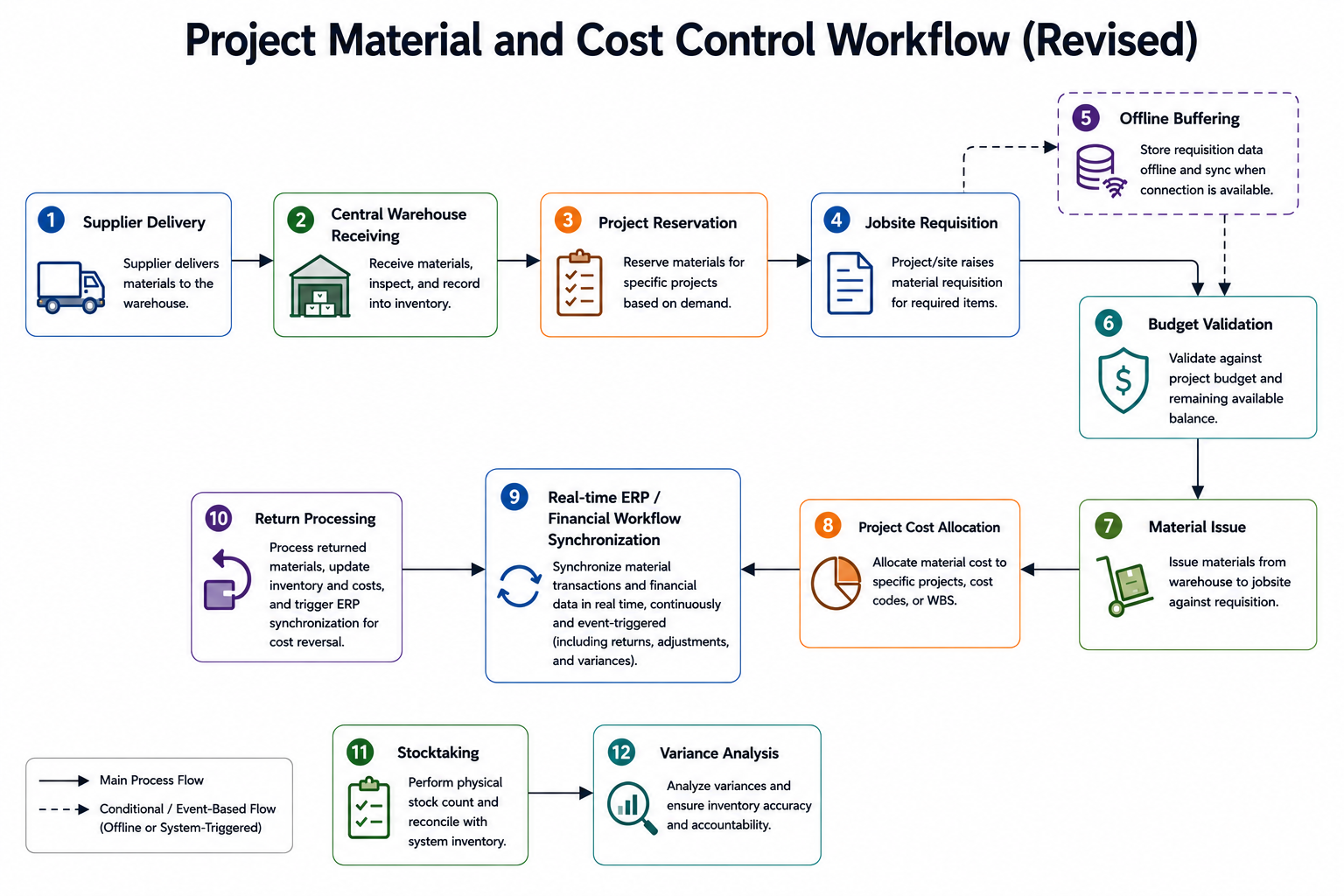
Material status model: The system classified materials as available, pending inspection, project-reserved, budget-validation pending, jobsite-held, in transfer, return-pending inspection, exception-held, offline-pending synchronization, reusable, or consumed, helping warehouse, project, purchasing, and finance teams work from the same operating facts.
Real-time finance integration: During requisition approval or outbound confirmation, the system used real-time or near-real-time APIs to validate project codes, cost centers, budget availability, and approval status, then generate material issue records for ERP / financial synchronization.
Offline buffering and exception recovery: For low-risk consumables and pre-approved urgent requests, the system supported offline pending records and exception review tasks; for high-value tools, critical materials, and over-budget risk scenarios, stricter validation remained in place.
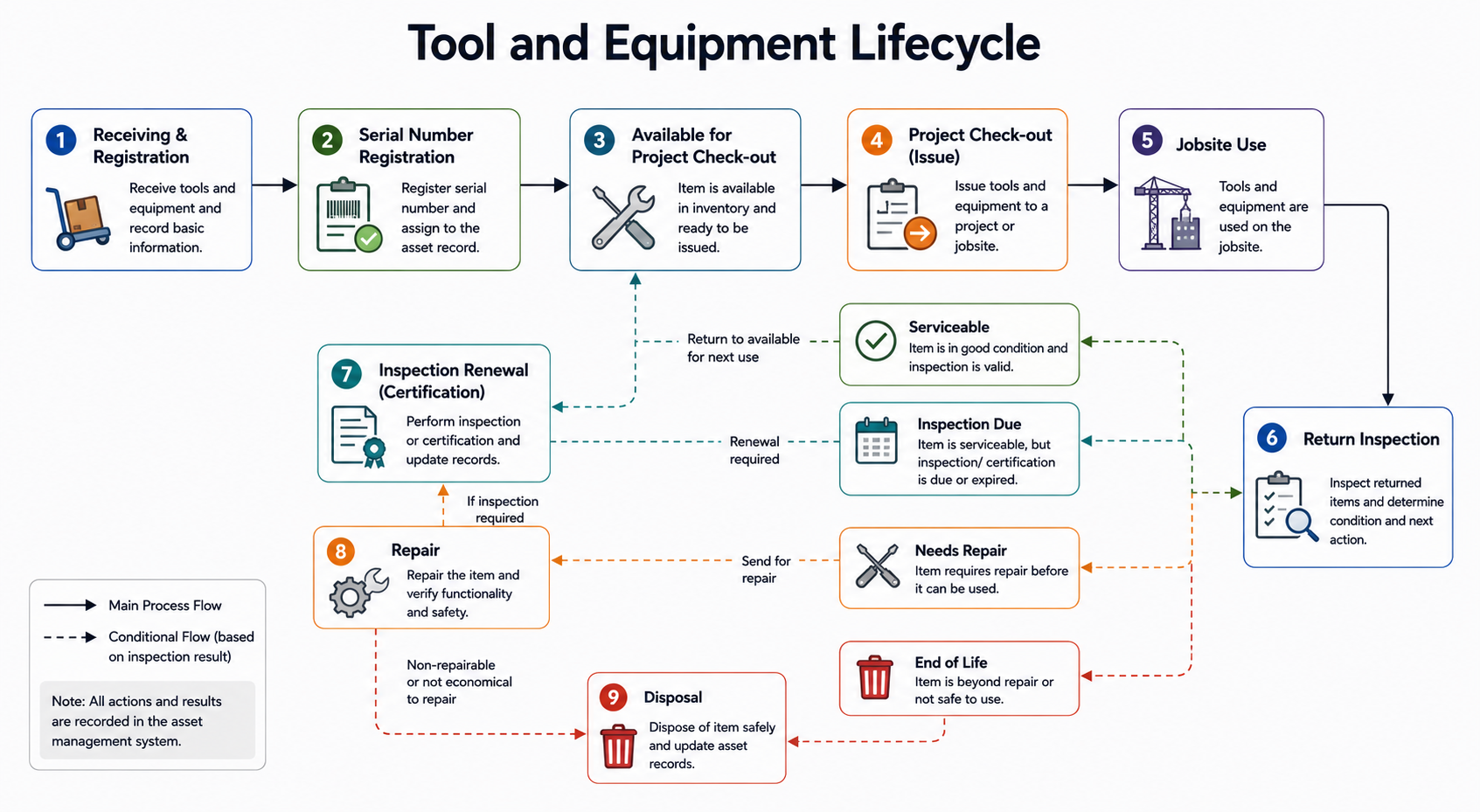
Tool and reusable asset lifecycle: The system supported serial numbers, custodians, assigned projects, check-out and return, inspection validity, repair, damage, disposal, loss rates, and cost ownership, turning tool management into a traceable, reviewable, and auditable lifecycle process.
Real-Time ERP / Financial System Integration
For a construction contractor, materials management cannot stop at warehouse quantity changes. Once materials move from the central warehouse to a jobsite, the system must also support budget validation, project cost allocation, financial review, and audit readiness. Industry Software designed the WMS integration with the customer’s existing ERP / financial system so project requisitions, material issues, cross-project transfers, returns, and loss records could enter a unified project cost management process.
In key issue scenarios, the WMS calls ERP / financial system interfaces during requisition approval or outbound confirmation to validate project codes, cost centers, material categories, budget availability, approval status, and outbound reasons. If the project budget is insufficient, the cost center does not match, or approval status is incomplete, the system can block the outbound movement or route the request into an approval queue. For validated transactions, the WMS generates material issue records that can be synchronized with the ERP / financial system to support project cost allocation, voucher generation, or financial review.
The integration does not rely entirely on overnight batch files. For critical events related to budget control, project cost, and material issue records, the project uses real-time or near-real-time API synchronization so financial data can follow field execution more closely. For low-risk reference data, historical records, or management reporting, scheduled batch synchronization can still be used based on the customer’s IT strategy, balancing real-time control with system stability.
The system also supports offline buffering and exception recovery for jobsites with unstable network conditions. For critical path materials, high-value tools, or requisitions that may create over-budget risk, the system can require ERP / financial validation before release based on customer rules. For low-risk consumables, pre-approved urgent requests, or temporary network interruption scenarios, the system can create offline pending records and exception review tasks, then synchronize outbound records, budget validation results, and project cost data once connectivity is restored.
This integration helps warehouse execution, project management, and finance work from the same operating facts. Project managers can see budget constraints before requisition release, warehouse teams can confirm financial validation results during outbound execution, and finance teams can reduce manual voucher entry after warehouse issue. The WMS becomes more than a warehouse tool; it becomes an operating system connecting project execution, budget control, jobsite continuity, and cost accounting.
Tool and Reusable Materials Lifecycle Management
Construction inventory includes more than one-time consumables. Tools, equipment, and high-value reusable materials require more detailed lifecycle records as they move across projects and jobsites. Industry Software configured the system to manage serial numbers, custodians, assigned projects, check-out dates, expected return dates, actual return dates, inspection validity, repair history, damage reasons, disposal status, and cost ownership fields.
The system can distinguish ordinary consumables, reusable materials, tools, equipment, and high-value assets. Consumables are managed mainly through quantity, project assignment, and loss records, while tools and equipment can be tracked by SN code, current custodian, usage status, inspection due date, repair status, and disposal reason. For high-loss or high-value materials, the system can record normal loss, abnormal damage, jobsite loss, and disposal reasons, supporting project cost review and site management.
Loss rates became part of the project review logic. The system can connect project, material category, issued quantity, returned quantity, damaged quantity, and disposed quantity, helping the customer distinguish normal loss, abnormal damage, and reusable stock. For a construction contractor running multiple projects, these records help leadership identify projects with higher-than-expected loss, tools with low utilization, and field rules that need further improvement.
This configuration makes the system better suited to real construction environments, not only standard warehouse operations. Project teams can see whether tools are in use, overdue, due for inspection, or under repair. Warehouse teams can reduce duplicate purchasing and tool loss, while leadership can review material loss rates and equipment utilization across projects.
Implementation Process
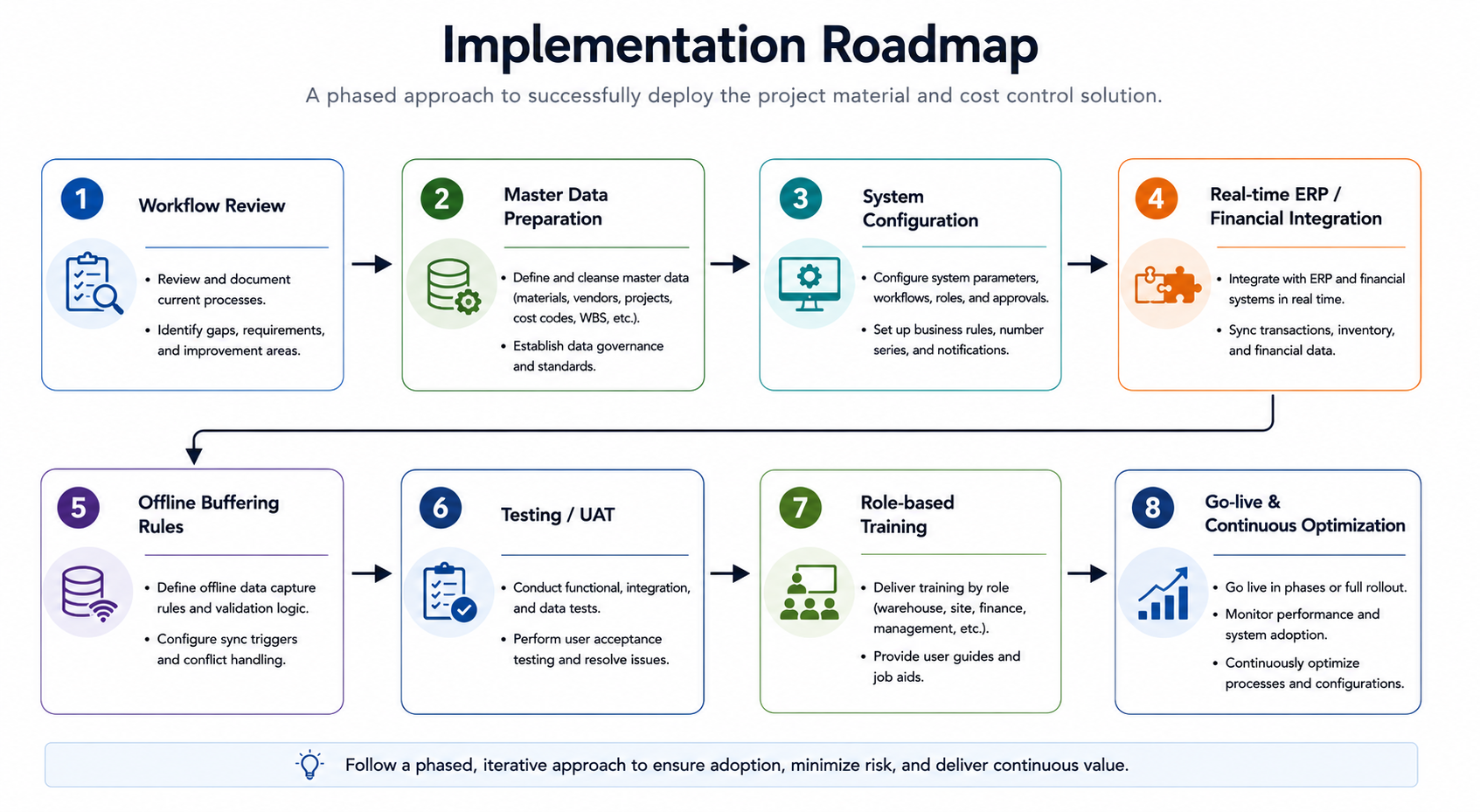
The project followed a phased implementation model, starting with the central warehouse, two representative jobsites, and high-frequency material categories. Industry Software did not apply a generic warehouse template directly. Instead, the project team worked with warehouse supervisors, project managers, purchasing leads, finance users, IT teams, and site coordinators to review actual material movement across supplier receiving, inbound inspection, project reservation, budget validation, jobsite requisition, cross-project transfer, tool check-out and return, return inspection, stocktaking, and project cost allocation.
After the workflow review, the project team helped the customer prepare item master data, tool and equipment registers, project codes, cost centers, location rules, material statuses, approval roles, and user permissions. Several areas that had not been clearly recorded before, such as tool inspection validity, return inspection status, transfer reasons, loss types, disposal reasons, and financial synchronization fields, were defined during implementation. As a result, the system could record not only inventory quantity, but also material destination, project ownership, budget validation result, cost impact, and responsibility checkpoints.
The integration stage focused on data fields, interface trigger points, and synchronization timing between the WMS and the ERP / financial system. The project team worked with the customer’s IT, finance, and project management users to confirm project codes, cost centers, material categories, budget availability, outbound types, return reasons, loss types, approval status, and voucher reference fields. For outbound confirmation, budget validation, and cost allocation, interfaces were triggered through real-time or near-real-time APIs; for non-critical reference data and historical reporting, scheduled synchronization was configured according to the customer’s policy.
The project team also confirmed offline operating rules with the customer, including which materials must wait for real-time budget validation, which low-risk items can enter offline buffering, and which exceptions require later review by project managers or finance users. With this configuration, the system does not simply release or block all transactions during network instability; it handles them by material value, project risk, and approval status. Once connectivity is restored, offline records enter synchronization and review workflows, helping balance jobsite continuity, budget control, and auditability.
The go-live plan used a focused rollout approach. The first phase stabilized receiving, locations, project requisition, tool check-out and return, and basic stocktaking, while the second phase extended real-time ERP / financial synchronization, offline exception recovery, return inspection, loss records, and management reporting. With cloud deployment, customer teams could access the system through a browser without complex local installation. Core workflows went live within 4–6 weeks, followed by adjustments to fields, permissions, approval nodes, interface rules, and reporting views based on field feedback.
Training and Adoption
Training was designed around each role’s daily work rather than system menus alone. Warehouse users focused on receiving, putaway, requisition issue, transfer, stocktaking, and exception handling, while project teams learned how to submit material requests, review budget validation results, check requisition status, confirm jobsite receiving, handle offline recovery prompts, and return tools. Purchasing users focused on available stock, project reservations, replenishment needs, and supplier delivery status, while finance users focused on material issue records, project cost fields, voucher references, return records, offline exception tasks, and loss categories.
To help the system become part of daily execution, the Industry Software implementation team continued to track user feedback after go-live. Some field names, approval nodes, mobile operation sequences, integration exception messages, offline synchronization prompts, and reporting views were adjusted based on actual site usage. This ongoing optimization helped the customer move from a system that was simply live to one that users could adopt, processes could rely on, and data could support review.
The customer also began to formalize internal management rules. Project managers used the system to check material requests, budget validation, and cost assignment, warehouse teams tracked stock status and tool movement, and finance teams used system records for project cost review. Teams no longer had to repeatedly reconcile spreadsheets, paper sign-off sheets, and manual records; they could work from the same material, project, budget, and cost data foundation.
Operational Results
An operational review conducted 8–12 weeks after go-live showed that materials status confirmation time decreased by 32%. Project managers and site teams could check whether materials had been received, reserved for a project, moved into transfer, or issued to the jobsite with less back-and-forth communication. For critical path materials, this visibility helped project teams identify schedule risks earlier.
Inventory discrepancy investigation time decreased by 38%. Status changes for materials, tools, and high-value reusable items were recorded in the system, making it easier for warehouse teams to trace the source of differences. Stocktaking also moved from heavy after-the-fact reconciliation toward continuous control based on status records, operating history, and project ownership.
Project cost tracking became clearer. Material issues, project requisitions, cross-project transfers, and returns could be synchronized with project cost workflows in the ERP / financial system through real-time or near-real-time APIs, reducing manual entry after warehouse issue. Project managers could understand whether materials had been assigned to the project, while finance teams could review costs and differences using more complete operating records.
Budget control moved from after-the-fact reconciliation into the outbound process. The system validated project codes, cost centers, budget availability, and approval status during requisition approval or outbound confirmation, then blocked or routed exceptions when rules were not met. This helped the customer identify over-budget risk before materials left the warehouse, rather than discovering cost deviations at month-end.
Jobsite continuity also improved under unstable network conditions. For low-risk items approved for offline buffering, field teams could complete necessary work and synchronize records once connectivity returned; for high-value tools, critical materials, or over-budget risk scenarios, stricter validation remained in place. The customer no longer had to choose between stopping field work entirely and losing financial control; it could apply layered rules based on business risk.
Tool and reusable materials management also became more structured. The customer could track key tools and equipment by serial number, project, custodian, and status, while recording damage, repair, overdue return, inspection expiry, and disposal information. For high-value reusable materials, loss records and return status became clearer, helping project teams distinguish normal loss, abnormal damage, and reusable inventory during project review.
Business Value
The implementation helped the customer build a materials management foundation better suited to project-based operations. Warehouse management moved beyond inventory quantity and became connected with jobsites, tools and equipment, ERP / financial workflows, budget validation, offline exception recovery, and project cost allocation. The customer could identify material shortages, tool occupation, transfer delays, over-budget requisitions, and project cost exceptions earlier, improving control over project execution.
From a long-term investment perspective, cloud deployment and modular implementation reduced the pressure of a large upfront rollout. The customer did not need to build a complex local environment from the beginning, and it could reduce reliance on scattered tools used to maintain the same inventory, project, and cost data. A unified system reduced duplicate entry, cross-spreadsheet checking, paper sign-off review, and repeated training effort, making future expansion more controlled.
For leadership, the value of the WMS extends beyond inventory accuracy. Whether materials arrive on time, are assigned to the right project, pass budget validation, enter project cost correctly, remain supported by available tools, and preserve traceability during offline operations can affect construction schedules, project margins, and delivery commitments. Industry Software helped the customer move warehouse management from a back-office support function to an operating foundation connected with purchasing, jobsite execution, financial review, and delivery control.
Client Quote
“Before the system went live, project closeout often required us to search through paper sign-off sheets and message records to understand whether a damaged generator should be repaired, disposed of, or charged to a project. Now tool usage, repair, disposal, offline recovery, material issue, and cost ownership are traceable in the system, making financial audits and project reviews much clearer without stopping the jobsite for every short network interruption.”