Results Snapshot
Quote preparation time for standard pump skids, filtration modules, and control panel combinations decreased by 45%
Engineering review volume decreased by 40%, allowing engineering teams to focus on truly nonstandard operating conditions and configurations
Discount and special pricing approval cycle time decreased by 35%, with approvers able to view margin, discount reason, and customer context in one place
Quote rework caused by incompatible options, outdated pricing, or version confusion decreased by 33%
Quote data began supporting analysis of distributor discounts, product mix margin, and high-risk nonstandard orders
A Quote Changed Four Times
The customer is a U.S. industrial fluid handling equipment manufacturer. Its products include pump skids, filtration modules, valve packages, control panels, instrumentation assemblies, and field start-up services. The company serves industrial water treatment, chemical processing, facility maintenance, engineering contractors, and regional distributors.
Before the project, one pump skid quote was revised four times internally. Sales selected a pump based on the customer’s flow and pressure requirements, the distributor later asked to add a spare seal kit and control panel, engineering found that the selected control panel did not match the motor voltage, and finance identified that the discounted margin was below the internal threshold. The customer eventually received a corrected quote, but the internal process had already gone through multiple emails, spreadsheets, pricing checks, and version resubmissions.
That quote changed how leadership framed the problem. Slow quoting was only the surface issue. The deeper challenge was inconsistent configuration rules, unclear pricing authority, too many engineering reviews, approval requests without enough context, and the risk that the customer-facing version would not match the version used for order handoff.
Risk Hid in Option Combinations
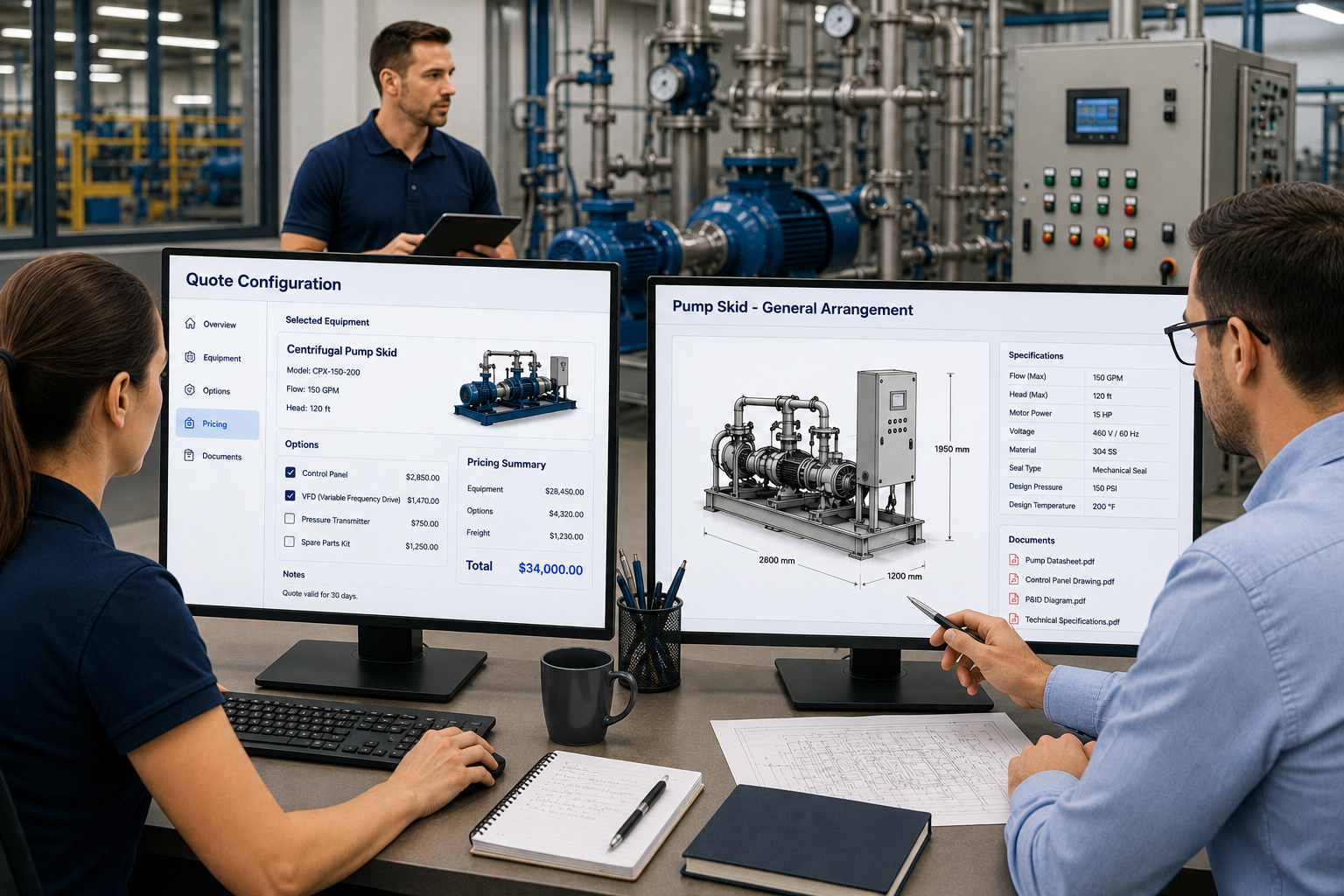
The most common quoting risk was not the price of a single product. It was the relationship between options. A pump model might be valid on its own, but once it was paired with a specific pressure range, media type, seal material, and customer voltage requirement, the combination could become unsuitable.
The customer had relied heavily on experienced sales and engineering users to catch those issues. That experience was valuable, but it was difficult to replicate for new sales users and distributor quote requests. Sales teams often copied old quotes and modified options, even though those old quotes might include outdated pricing, special discounts, or one-time engineering exceptions.
The project team helped the customer define which combinations could be quoted directly, which combinations should be blocked, and which combinations required engineering review. The rules covered pump models, flow range, pressure rating, materials, seals, motors, valve packages, control panels, instrumentation, certification requirements, spare parts, and service packages. CPQ did not replace sales judgment; it exposed incompatible or high-risk choices before a quote reached the customer.
Start with What Cannot Be Sold
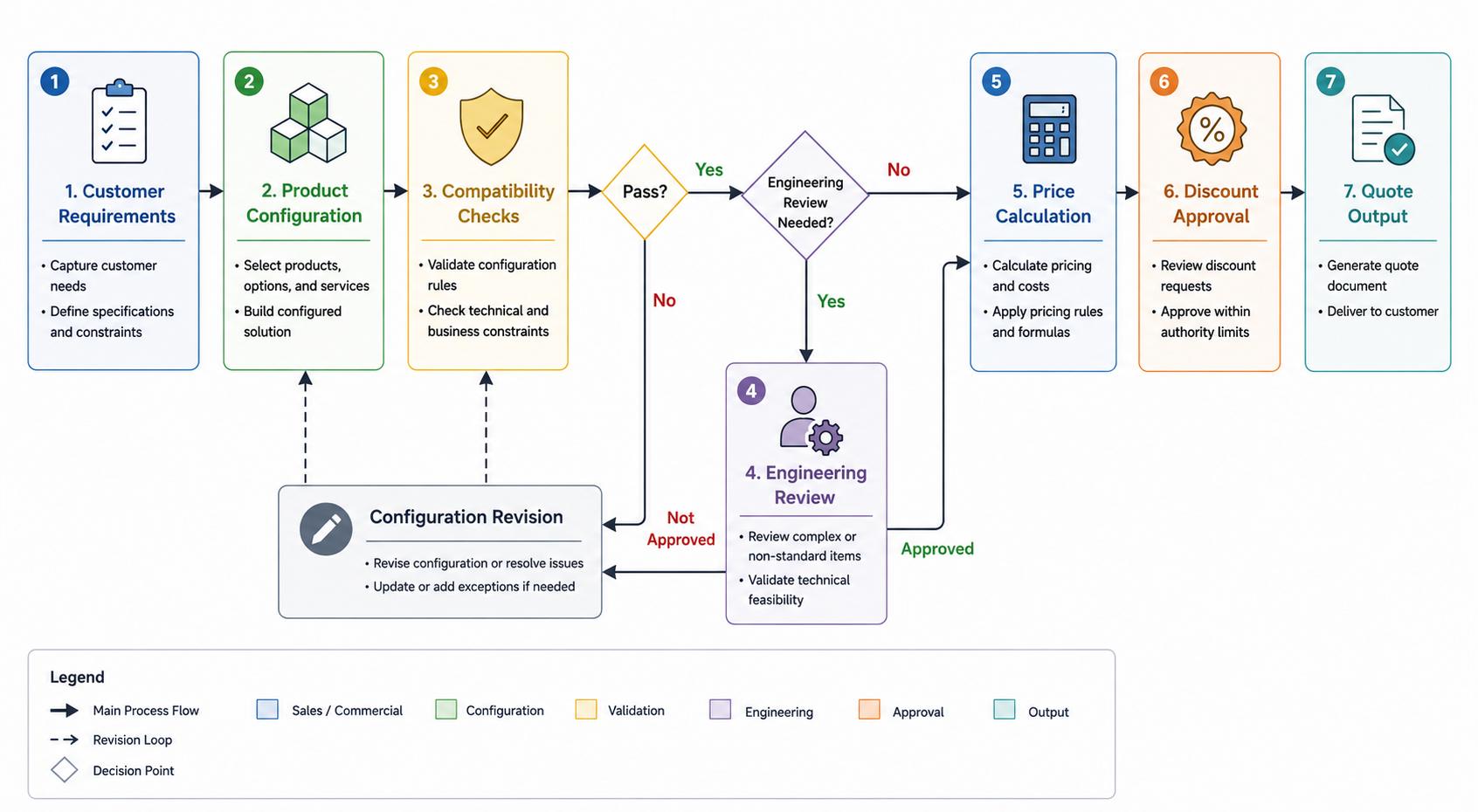
The first CPQ priority was not quote template design. It was defining configuration boundaries. The customer broke high-frequency pump skids, filtration modules, and control panel combinations into maintainable rules, including required options, mutually exclusive options, dependent options, boundary operating conditions, and engineering review triggers.
This changed the relationship between sales and engineering. Previously, sales users sent many near-standard quotes to engineering just to be safe, which consumed engineering time with repeat checks. After rules were configured, standard combinations could move directly into pricing, while special media, boundary flow and pressure conditions, customer-specified components, unusual certifications, and unvalidated control packages entered engineering review.
Engineering no longer served as the final checkpoint for every quote. It focused on scenarios that truly required technical judgment, such as high-temperature media, corrosive liquids, special sealing plans, custom control interfaces, or project-specific requirements. Sales users also gained clearer guidance on why a configuration was blocked and who needed to review it next.
Rules Stayed with the Business
One capability the customer valued was that configuration rules did not require IT teams to rewrite code every time the business changed. Industry Software CPQ Software allowed product management, sales operations, and engineering teams to maintain configuration logic together, including which options could be combined, which materials needed restrictions, and which operating conditions required engineering review. This kept product rules adaptable as product lines, distributor policies, and engineering experience evolved.
For complex industrial equipment quoting, that maintainability mattered. Pump models, seals, control panels, motors, voltages, certification requirements, and service packages can change with market needs, supplier availability, and customer requirements. The customer could adjust rules based on real sales feedback, such as adding a common configuration bundle, restricting a high-risk option, or routing specific nonstandard conditions into a multi-level technical review process.
This design also kept CPQ closer to how business teams manage quoting every day. Product teams could maintain product combination logic, engineering teams could update review triggers, and sales leaders could adjust channel policies and approval rules. The system became not a fixed quoting template, but a sales execution platform that could evolve with the customer’s business.
Approval Needed Context
Pricing approval had often centered on one question: whether the discount could be approved. Managers could see quote amount and discount percentage, but not always customer type, product mix, distributor tier, service scope, project context, or estimated margin. Approvals could still happen, but they were harder to evaluate consistently.
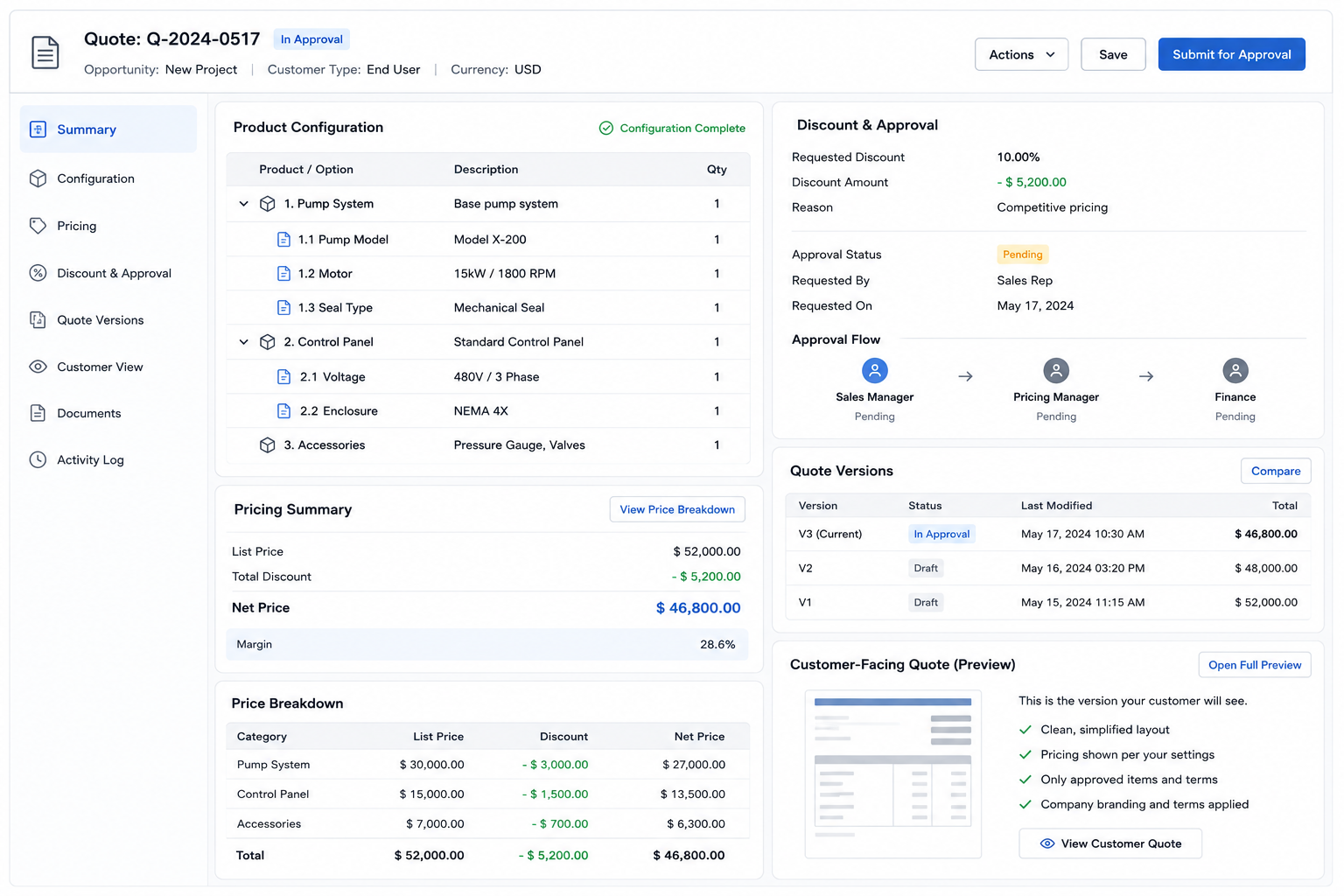
Industry Software placed pricing logic and approval context inside the CPQ flow. The system calculated quotes based on product line, customer type, distributor level, quantity range, service package, special material, and target margin. Quotes triggered approval when discounts exceeded authority, margins fell below thresholds, delivery terms were unusual, or configurations required engineering support.
Pricing control was also designed as a configurable workflow rather than a fixed approval form. The system could connect with finance or cost data to support real-time or near-real-time margin calculation, then trigger different approval paths based on product line, customer type, distributor tier, discount level, and special delivery terms. For higher-risk quotes, the workflow could require sales leadership, finance, and engineering review together, preventing teams from looking only at discount percentage while missing technical or margin risk. Approvers saw more than a discount request. They could review customer background, quote version, product mix, discount reason, estimated margin, and special terms. Sales teams still had room to request pricing exceptions, but each exception carried a reason and approval record.
Engineering Focused on Exceptions
Once engineering review was redefined, the quote queue became cleaner. Standard pump skids, common materials, common voltages, validated control packages, and standard service bundles no longer entered the review queue as often. Engineering received nonstandard requests with operating conditions, selected options, risk prompts, and customer requirements already attached.
This reduced waiting time inside the quote process. Sales users no longer had to send every complex-looking question through email and wait for a response, while engineering no longer had to reconstruct customer requirements from scattered messages. Configuration, operating context, trigger reason, and quote details were available together.
Customers felt the difference through more stable responses. Standard needs received pricing faster, while special requirements came with clearer explanations of why review was required. Sales users could explain the technical boundary instead of simply saying the quote had to wait for engineering.
Versions Became the Handoff
Complex quotes rarely finish in one pass. Customers revise flow requirements, distributors add spare parts, sales requests discounts, engineering changes components, and finance asks for a new approval. Previously, those versions lived in email attachments, local files, and personal records, creating risk that the customer received an old quote or order operations worked from the wrong version.
CPQ brought quote versioning into one controlled process. Each configuration change, price adjustment, discount approval, engineering review, and customer-facing version could be recorded. Sales users could identify the active quote, approvers could trace pricing changes, and order operations could review final configuration, pricing basis, and approval history after customer acceptance.
Version control also improved customer communication. Sales could explain whether a quote changed because of a material upgrade, control panel change, service package adjustment, or discount approval result. For project customers and distributors, this reduced repeated confirmation and lowered the risk of disputes during quote-to-order handoff.
Customization Was Built In
Industry Software’s CPQ projects are not delivered as generic templates. From the start, the system is configured around the customer’s product structure, sales channels, distributor policies, engineering review logic, and pricing approval rules. Standard configurations, distributor discounts, low-margin orders, nonstandard operating conditions, special materials, and customer-specified components can follow different workflows, allowing the system to match the customer’s real quoting process.
This customized approach matters especially in complex industrial equipment quoting. Every manufacturer has different product combinations, engineering risks, pricing authority, and channel policies, so a single quoting template cannot reflect the way the business actually sells. Industry Software uses configurable rules, adjustable approval paths, and maintainable product logic to make CPQ part of the customer’s sales execution process rather than a tool layered on top of it.
Customization also reduced long-term maintenance pressure. When the customer adds product lines, changes distributor policies, revises margin thresholds, or introduces new engineering review triggers, the quoting process does not need to be rebuilt from scratch. The system can expand on the original logic, keeping sales execution controlled as the business changes.
Not the Entire Catalog
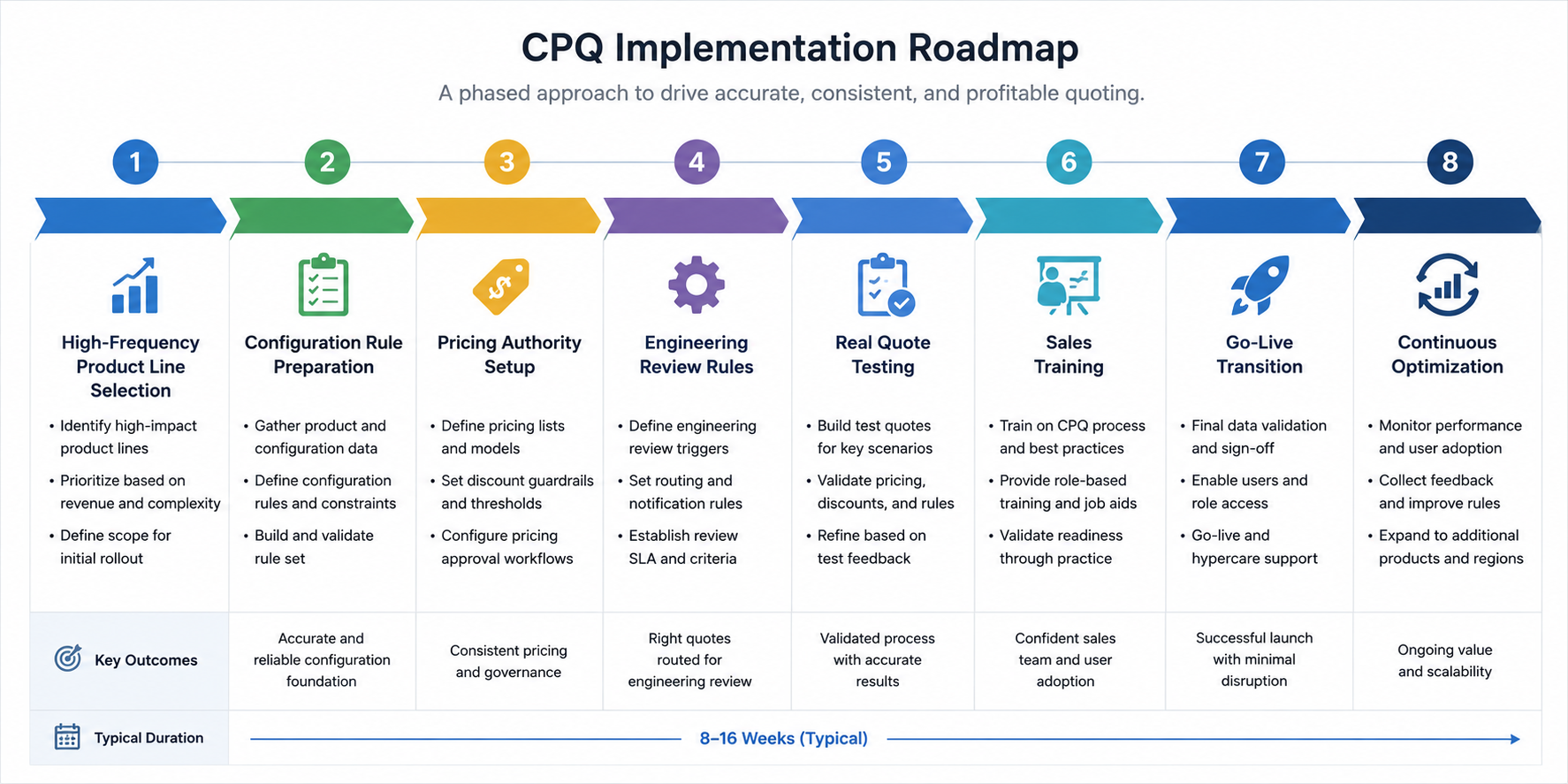
The customer’s product catalog was broad, and historical quotes included legacy models, discontinued configurations, distributor-specific pricing, and one-time project exceptions. Bringing every historical rule into CPQ at the start would have slowed the project and carried outdated exceptions into the new process. The team decided not to begin with the full catalog.
The first phase focused on standard pump skids, filtration modules, and control panel combinations. These product lines had high inquiry volume, relatively clear rules, frequent engineering review, and regular quote rework. They provided the best test of whether configuration rules, pricing authority, discount approval, and engineering review would work in daily sales.
Historical pricing data was also cleaned selectively. The project team prioritized active products, common options, major distributor tiers, standard service packages, and high-frequency quotes from the previous year. Low-frequency legacy quotes remained available as reference information but did not drive automated rules.
Sales Had to Use It
The success of CPQ depended not only on rule quality, but also on whether sales teams would quote inside the system. Some senior sales users worried that rules would reduce flexibility, while newer sales users worried that configuration steps would slow response time. Training therefore focused on real selling situations instead of feature-by-feature instruction.
Sales users practiced selecting products from customer operating conditions, responding to incompatibility prompts, requesting discounts, submitting engineering reviews, and generating customer quotes. Engineering users learned how to review nonstandard requests with trigger reasons and configuration context. Finance and sales leaders learned how to approve based on margin, discount reason, and customer type.
After go-live, the implementation team continued to adjust the workflow. Some fields were combined, frequent configurations became quick selections, discount reasons were standardized, and engineering review prompts became more specific. The system gradually matched daily sales behavior more closely, reducing the likelihood that users would return to old spreadsheets and copied quotes.
The Change Showed Up in Quotes
After core workflows went live, quote preparation time for standard configurations decreased by 45%. Sales users could select products, validate options, calculate pricing, and generate customer quotes inside one process instead of copying and modifying older quotes. For distributors and engineering contractor customers, initial response time and scenario comparison improved noticeably.
Engineering review volume decreased by 30%. Standard combinations no longer entered the engineering queue as often, while nonstandard configurations arrived with clearer operating conditions, selected options, and risk prompts. Engineering time moved toward special media, boundary operating conditions, and project-specific customization.
Discount and special pricing approval cycle time decreased by 35%. Approvers could view customer type, product mix, discount reason, quote version, and estimated margin in one place, rather than reviewing only a discount percentage. Sales teams also received faster visibility into approval status, reducing follow-up through email.
Quote rework caused by incompatible options, outdated pricing, or version confusion decreased by 33%. After customer acceptance, order operations could review final configuration, approval history, and pricing basis. The quote-to-order handoff became more stable and required fewer corrections.
Margin Discipline Started Earlier
The long-term value of CPQ extends beyond quote speed. For industrial equipment manufacturers, the quote stage already shapes downstream outcomes: whether the customer commitment is accurate, whether engineering resources are used well, whether discounts are justified, whether margin is protected, and whether the customer receives the right version. Bringing those decisions into the quote flow reduced later rework and margin uncertainty.
As quote data accumulated, management gained a stronger view of margin risk. With discount approval cycle time reduced by 35%–45%, the team could also review which distributors, customer types, product lines, or selling scenarios most often triggered price exceptions. With quote rework reduced by 25%–33%, the customer also reduced hidden time costs across sales, engineering, and order operations.
Industry Software helped the customer build more than a quote calculator. Configuration rules protected technical accuracy, pricing authority protected margin discipline, and version control protected customer commitments. For complex industrial equipment businesses, CPQ turned quoting from experience-driven work into a repeatable, approvable, and traceable sales capability.
Client Quote
“The pump skid quote that changed four times made the problem obvious. The customer only wanted a reliable proposal, but internally we changed the configuration, added engineering confirmation, reran discount approval, and then had to confirm which version could actually be sent. Now sales sees incompatible options and approval requirements while quoting, engineering reviews only true exceptions, and the version sent to the customer is much more reliable.”