Results Snapshot
Priority accounts, site hierarchies, contact roles, sales opportunities, service issues, and renewal reminders moved into shared management within 6–8 weeks
Customer meeting preparation and context lookup time decreased by 36%, reducing last-minute searches through emails, tickets, and personal notes
Sales handoff gaps and overdue follow-up items decreased by 24%, reducing relationship disruption during territory changes or account owner transitions
Time to pass service issues to sales and account managers decreased by 28%, allowing field risk to enter relationship management earlier
Renewal and expansion sales preparation time decreased by40%, with teams using site equipment, service records, and energy improvement opportunities to guide customer conversations
Leadership gained visibility into relationship health by account portfolio, contract expiry, service risk, contact coverage, and site value
An Overnight Fault Call Exposed the Blind Spot
The customer is a UK building automation and facilities engineering services provider. It supports commercial offices, university campuses, hospitals, retail properties, and light industrial facilities with building management systems, control panels, HVAC controls, sensors, energy monitoring, maintenance services, and field engineering support. Customer relationships rarely revolve around one buyer; they involve property owners, facilities managers, energy managers, site maintenance teams, procurement, and external contractors.
Before the project, a long-term education customer had an overnight building controls fault. The on-call service team could see the ticket, but not that the customer was discussing an energy optimization project across three buildings. The sales team knew the renewal was approaching, but not that fault frequency had recently increased. A field engineer remembered that one building’s controller was nearing replacement, but that note lived in a personal report rather than a shared customer view.
The incident changed how leadership viewed CRM. The issue was not whether sales had recorded the customer; it was that the customer relationship had been split across sales, service, field engineering, and management. Industry Software CRM System was implemented to turn account information, site history, service risk, contact networks, and commercial opportunities into customer facts the team could use together.

A Customer Was a Set of Sites and Roles
In facilities engineering, a customer is rarely just a company name. A large account may include several sites, and each site may have different equipment conditions, service contracts, maintenance history, energy targets, and site contacts. Headquarters procurement may own the framework agreement, while facilities managers, engineering leads, and maintenance teams shape daily satisfaction and expansion potential.
The customer’s previous data structure could not fully represent this relationship. Sales systems held accounts and contacts, service systems held tickets and site addresses, engineers kept equipment notes, and leadership learned about account status through meetings. Each team held part of the truth, but no single view showed which sites belonged to the account, who influenced decisions, which facilities carried risk, and which service events affected renewal.
These gaps became most visible during renewals, complaints, and expansion discussions. A customer could be dissatisfied with service at one site while sales continued renewal discussions as usual. A field engineer might know that a control system needed upgrading, but that information might not become a sales opportunity. When a customer contact changed roles, internal teams might still treat the old contact as the primary decision maker. CRM had to structure the relationship, not just store contact names.
Accounts Connected to Site Portfolios
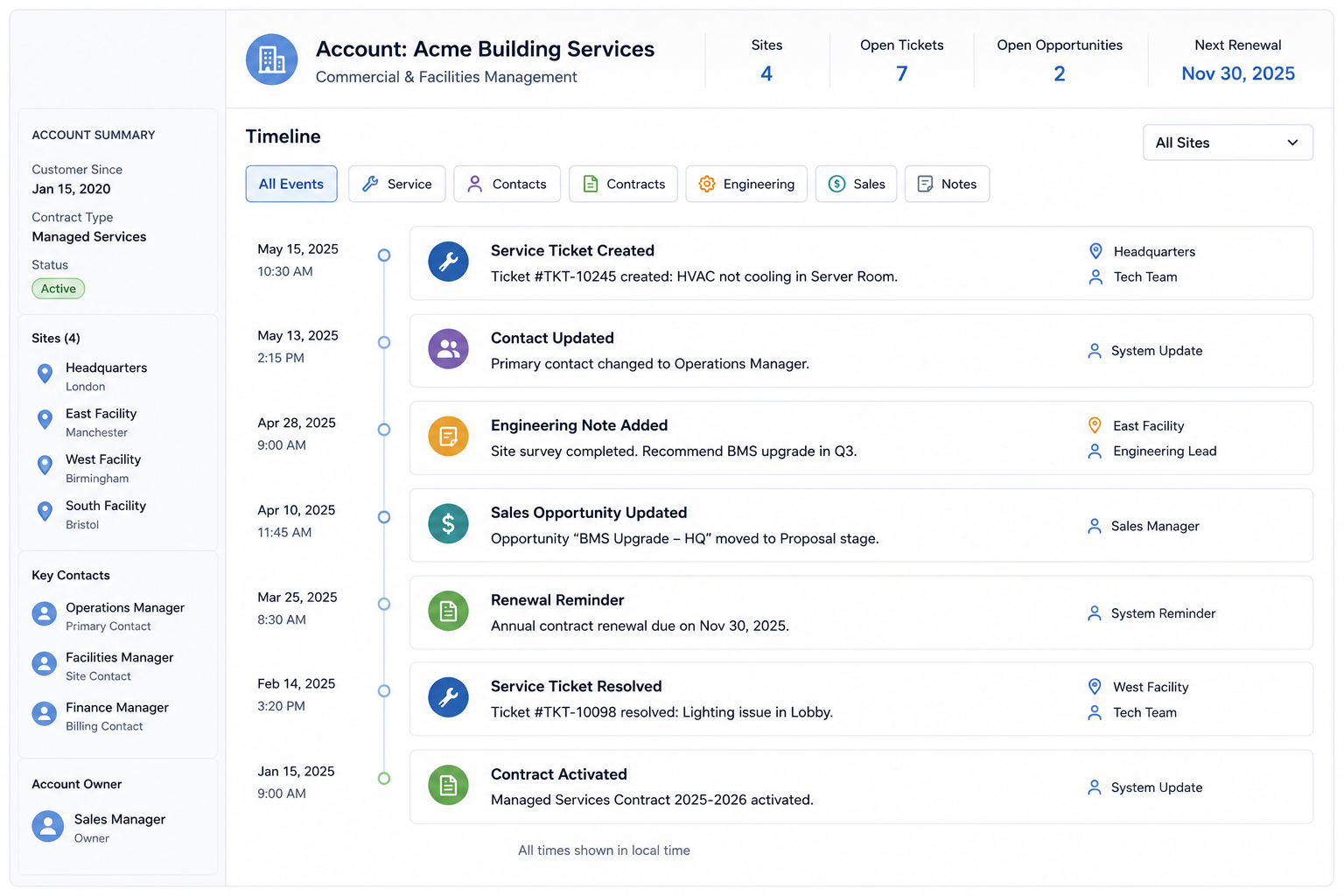
Industry Software and the customer team designed CRM to manage both accounts and site portfolios. A customer account could include multiple buildings, campuses, or facilities, with each site connected to equipment categories, service contracts, site contacts, service history, open issues, and potential upgrade opportunities. The customer record became a set of active relationships and operating facts, not just a name.
Sales teams could review the overall account relationship, contract status, renewal dates, key contacts, and active opportunities. Service teams could review sites, tickets, fault types, response records, and open items. Field engineering teams could add equipment status, technical constraints, replacement recommendations, and follow-up requirements so that these signals became part of the customer relationship view.
This account structure made customer discussions more specific. Teams no longer only said that an account was important; they could see which sites carried service risk, which contacts needed coverage, which equipment might lead to upgrade opportunities, and which contracts were approaching renewal. Customer relationships became manageable account portfolios instead of vague relationship judgments.
Service History Entered Sales Visibility
Sales opportunities in facilities engineering often come from the service environment. Repeated alarms may reveal ageing controls, an overnight fault may support a maintenance agreement upgrade, abnormal energy usage may create an optimization project, and a customer complaint may affect renewal. If sales only reviews opportunity value and contract dates, it may miss the service experience shaping the relationship.
After CRM go-live, service history entered the account manager’s view. Account pages could show major service events, repeated faults, open issues, response-time risks, and field engineering notes. When account managers prepared for renewal or quarterly business review meetings, they could see recent service experience instead of relying on verbal reminders from service teams.
This connection also made service signals more valuable commercially. Field engineers’ observations about ageing equipment, controller compatibility issues, or energy optimization suggestions could become account risks or sales opportunities. Service was no longer only a post-sale cost center; it became a source of relationship protection and expansion insight.
Contact Relationships Became Visible
Relationship risk often hides in weak contact coverage. A long-term account may have only one facilities manager recorded, while renewal decisions also involve procurement, finance, energy leadership, and property directors. Another account may depend heavily on an external contractor’s technical recommendation, but the sales record may only show the customer’s headquarters contact.
Industry Software helped the customer build contact roles and relationship mapping inside CRM. The system could distinguish decision makers, influencers, daily users, site contacts, procurement contacts, technical reviewers, and external partners. Sales users recorded not only names and phone numbers, but also each person’s role in the customer organization and connection to sites, projects, contracts, or service issues.
Once contact relationships were clearer, customer meeting preparation improved. Teams could see whether they had only daily operational contacts, whether senior relationships were missing, whether engineering should join a technical meeting, or whether service leadership should participate in a renewal discussion. Customer relationships became something the team could understand and maintain together, not only something an individual salesperson remembered.
Customized Around Contracts and Sites
Industry Software’s CRM projects are not delivered as generic contact tables. From the start, the system was configured around the customer’s service contracts, site portfolios, field engineering workflow, and renewal management model. The project team worked with the customer to define account hierarchy, site fields, contact roles, service risk tags, renewal reminders, opportunity types, and management dashboards.
This customization mattered for a facilities engineering services provider. A basic CRM field structure cannot fully express the reality of one customer with multiple sites, multiple contracts, several service levels, and several influence paths. The system needed to support sales opportunity movement, service risk alerts, field engineering notes, contract renewal, and account portfolio analysis together.
The customer also needed workflows that reflected its own service model. High-value sites, contracts nearing expiry, customers with repeated faults, energy optimization opportunities, and complaint escalations could trigger different reminders and follow-up actions. Industry Software used configurable fields, adjustable reminder rules, and role-based views to make CRM a customer relationship operating system rather than an extra data-entry layer.
Next Actions Left the Inbox
Customer relationships often weaken not because nobody owns them, but because the next action stays in someone’s inbox. After a customer meeting, who sends the proposal, who follows up on the service issue, when the engineer submits site recommendations, and whether renewal reminders happen early enough can all be buried in email, calendars, or chat. During handoffs, those actions are easy to lose.
During implementation, Industry Software placed next actions inside account, site, opportunity, and service risk workflows. Each priority account could carry next steps, owners, due dates, related contacts, and linked sites. For service-risk accounts, the system could remind account managers to arrange follow-up. For contracts approaching expiry, it could generate renewal tasks in advance. For upgrade signals found by engineers, it could create sales follow-up leads.
This turned relationship management from personal reminders into shared accountability. When territories changed, employees were away, or accounts were reassigned, the new owner could review history, open items, and next actions. Leadership could also see which priority accounts lacked recent activity, which renewals had not started early enough, and which service risks had not entered customer communication.
Start with the Accounts That Mattered
The project did not try to clean every historical customer record on day one. The customer had accumulated many accounts, contacts, sites, service reports, and old contracts, including duplicates, outdated contacts, and low-frequency customers. Cleaning everything to perfection first would have slowed the CRM rollout and delayed user value.
Industry Software and the customer selected the first group of priority accounts for focused management. The scope included accounts with higher annual service revenue, multi-site customers, customers with recent service issues, contracts approaching expiry, and accounts with potential energy optimization or control system upgrade opportunities. Low-frequency historical customers remained in basic records and could be enriched later based on business needs.
This path moved CRM into real customer work faster. Sales teams could prepare meetings around priority accounts, service teams could link key tickets and site risks to account records, and leadership could see contract and service risk for the most important customers first. Early value came from visibility into critical relationships, not from a large data migration alone.
Field Teams Had to Leave Useful Signals
CRM adoption depended on whether teams were willing to leave information that made the next customer interaction better. Sales users worried about data entry time, service coordinators worried about duplicate records, and field engineers did not want the system to become extra administration. Industry Software therefore focused training on whether the next customer contact would have better context, not on a list of software features.
Sales teams practiced updating contact roles, maintaining next opportunity steps, reviewing service risk, and preparing customer meetings. Service teams learned how to connect major service events to accounts and sites, then flag risks that account managers needed to see. Field engineers were asked to leave high-value signals, such as ageing equipment, compatibility limits, repeated faults, recommended follow-up inspections, or potential upgrade opportunities, instead of entering long low-value notes.
After go-live, page layouts and required fields were adjusted based on feedback. For frontline users, unnecessary fields were reduced while next steps, sites, contacts, service risk, and engineering recommendations were emphasized. For leadership, CRM kept portfolio, renewal risk, service risk, and contact coverage views, supporting both daily work and management review.
Leadership Saw Renewal Risk Earlier
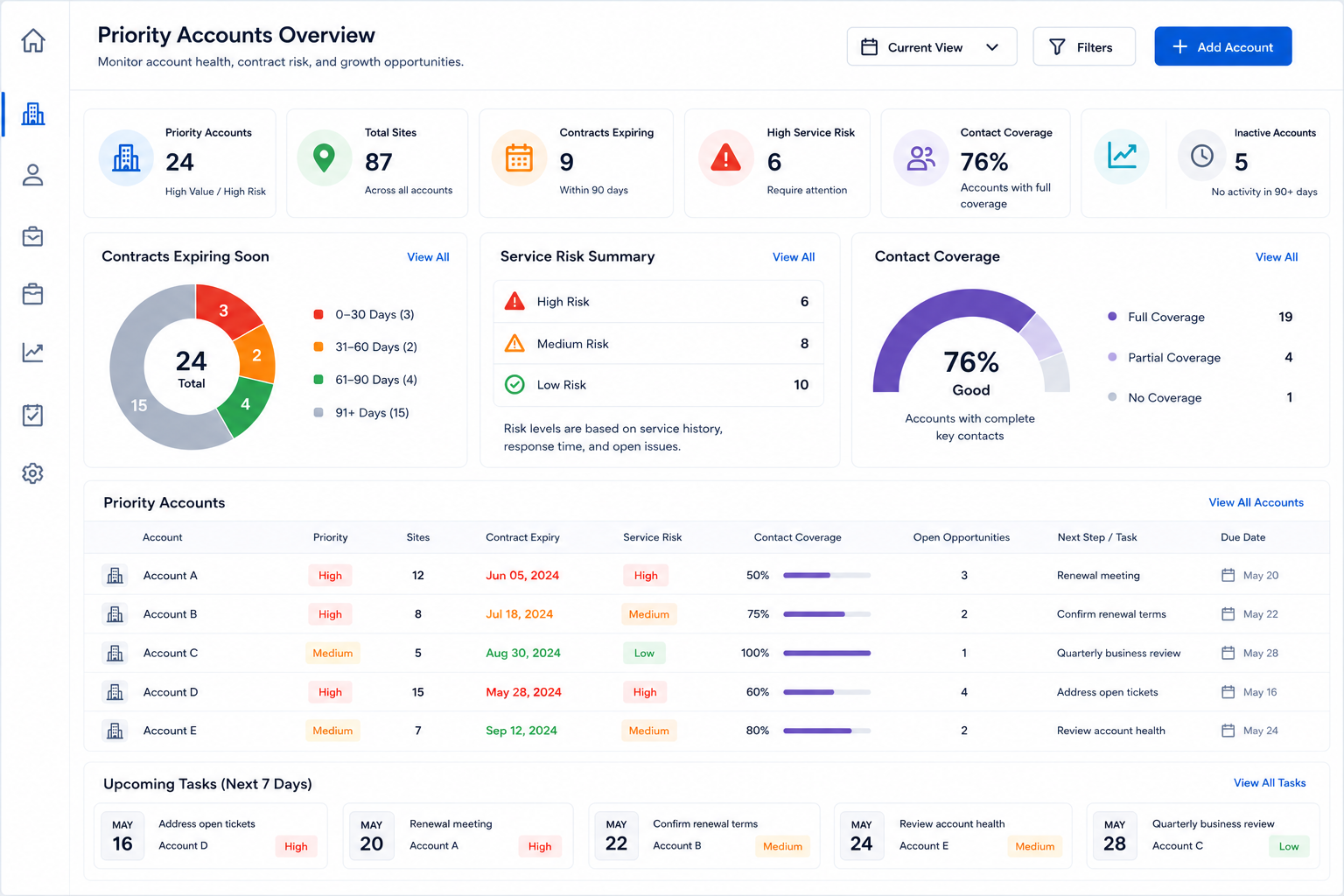
After CRM went live, leadership started seeing relationship gaps that had previously been difficult to measure. Some priority accounts had high service volume but no clear renewal owner. Some multi-site customers had only one headquarters contact and weak site-level coverage. Some customers had repeated faults, but sales had not yet joined a relationship recovery conversation.
Account reviews became more specific. Leadership could review portfolios by customer tier, contract expiry, site count, service risk, open opportunity, and contact coverage. Sales meetings no longer focused only on when an opportunity would close; they could also cover whether the relationship was stable, whether service issues had been addressed, whether engineering recommendations had become actions, and whether renewals had started early enough.
This visibility made customer relationships a manageable asset. Sales, service, and engineering no longer maintained separate versions of customer understanding. They contributed to one account view that improved renewal stability, expansion selling, customer satisfaction, and long-term account value.
Collaboration Data Became Growth Signals
After core workflows went live, customer meeting preparation and context lookup time decreased by 36%. Account managers could review sites, contacts, service issues, historical quotes, engineering notes, and next steps on the account page instead of asking several teams for information. For quarterly business reviews and renewal meetings, this helped teams move faster into the issues customers cared about.
Sales handoff gaps and overdue follow-up items decreased by 24% During territory changes, account owner transitions, or opportunity transfers, the new owner could review customer history, contract status, service risk, and open actions. Customer relationships were less likely to be disrupted by one person leaving, changing roles, or being unavailable.
Time to pass service issues to sales and account managers decreased by 28%. Repeated faults, open complaints, field engineering recommendations, and equipment replacement signals entered the customer relationship view earlier. Renewal and expansion sales preparation time also decreased by 30%, because teams could prepare customer conversations around site equipment, service history, and contract timing.
Leadership gained a clearer view of the account portfolio. Teams could review relationship quality by customer tier, industry, site count, contract expiry, service risk, contact coverage, and open opportunities. CRM became more than a sales activity tracker; it became a collaboration system for customer relationships, service risk, and growth opportunities.
Relationship Capability Became Repeatable
The long-term value of CRM is not only centralized information. For building automation and facilities engineering services providers, real customer relationship capability comes from multiple teams using the same customer facts consistently. Sales knows contracts and opportunities, service knows site issues, engineering knows technical constraints, and leadership knows relationship risk; when those facts connect, customer experience becomes more stable.
As data accumulates, the company can analyze the customer lifecycle more systematically. Which sites most often create upgrade opportunities, which service issues affect renewal, which customers lack key relationship coverage, and which engineering recommendations convert into sales opportunities can all become visible through CRM data. Customer relationship management moves from individual experience to repeatable team capability.
Industry Software helped the customer build more than a contact database. It created a customer relationship system organized around accounts, sites, service, renewals, and team collaboration. It made customer information transferable, next actions traceable, and service risk visible to sales. For facilities engineering businesses, CRM value comes not from recording more activity, but from helping teams serve customers, advance renewals, and identify long-term growth opportunities more consistently.
Client Quote
“After that overnight fault, the customer asked for a review meeting the next day, and we realized how scattered the information was. Service knew the fault, sales knew the renewal, and the engineer knew the controller was nearing replacement, but there was no single place showing the site, contacts, contract, service history, and next actions together. Now we can see those relationships and risks before customer meetings, so handoffs no longer feel like starting from zero.”